This post contains affiliate links. As an Amazon Associate, we earn from qualifying purchases.
- The Hidden Architecture of Crystal Formation
- The Seven Crystal Systems: Nature’s Sacred Geometry
- Crystalline vs. Amorphous: Why Structure Shapes Your Magic
- What Gemologists Know That Most Witches Don’t
- Common Stones That Aren’t Crystals (And Why That’s Okay)
- A Practical Ritual for Charging True Crystals by the Moon
- Related from our network
- Unlock Your Moon Magic
- Unlock Your Moon Magic
- Unlock Your Moon Magic
Disclosure: This post contains affiliate links. If you click through and make a purchase, we may earn a small commission at no extra cost to you. Thank you for supporting this site!
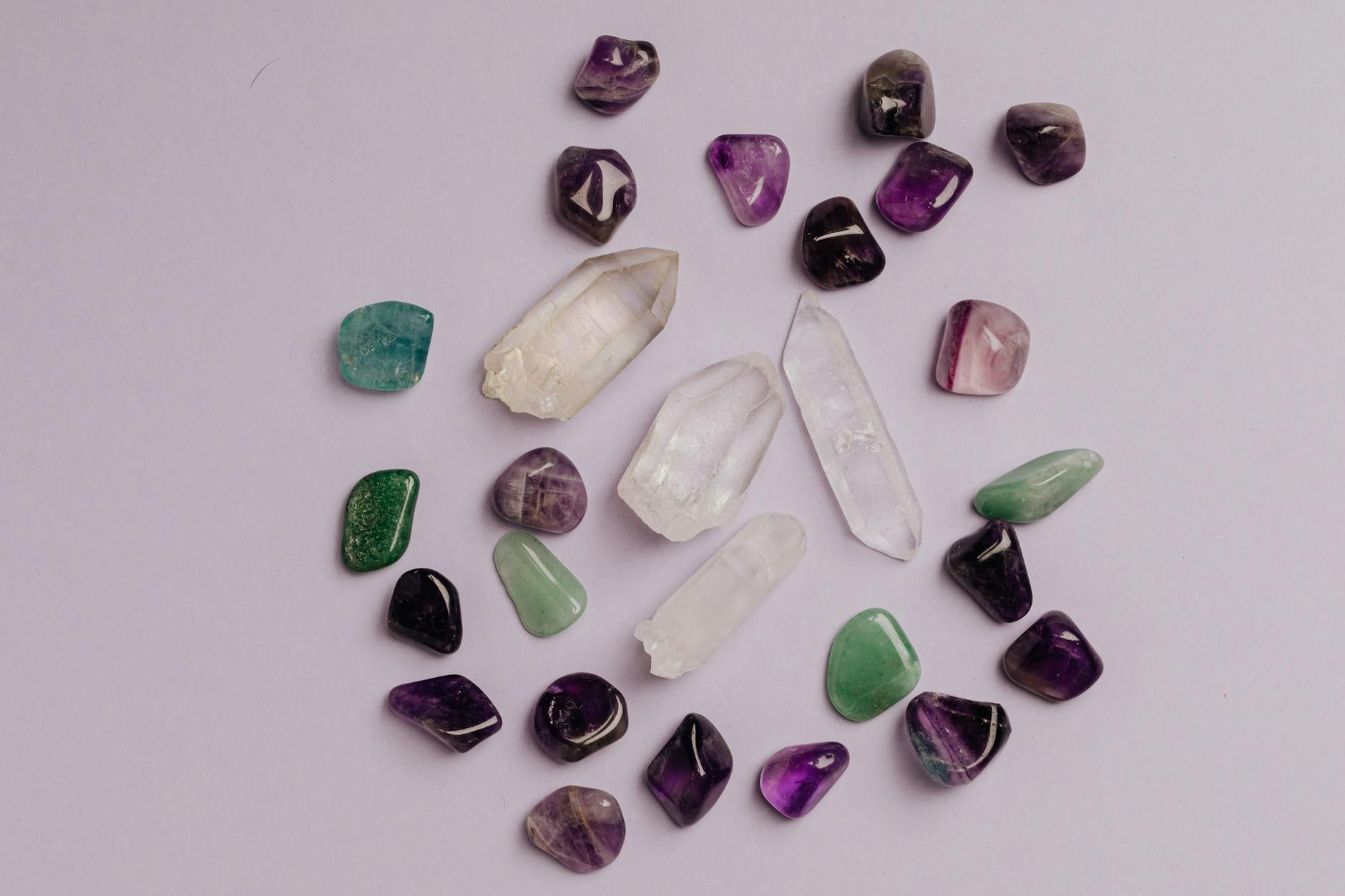
When you hold a piece of clear quartz in your palm during a waning gibbous moon, feeling that familiar hum of energy, you’re touching something with a secret life. That stone’s atoms are arranged in a repeating pattern so precise that if you could see at the molecular level, you’d witness a three-dimensional grid stretching in perfect symmetry. But here’s the truth that might unsettle your practice: many of the stones you’ve lovingly placed on your altar aren’t technically crystals at all—at least not by the definition used by gemologists at the International Gem Society. The word “crystal” gets thrown around like moon water at a sabbat gathering, but the scientific line between a true crystal and an amorphous solid is razor-sharp. And knowing that line? It changes how you work with your tools, how you charge them, and how you understand the ancient conversation between Earth and Moon that birthed them. Let me walk you through what a crystal actually is—scientifically, magically, and practically—so your next full moon charging ritual carries the weight of genuine understanding.
The Hidden Architecture of Crystal Formation
A crystal, by the gemological definition used by the International Gem Society, is a solid material whose atoms are arranged in a highly ordered, repeating three-dimensional pattern. This isn’t poetic metaphor—it’s a measurable structure called a crystal lattice. The key word is “repeating.” If you could zoom into a piece of amethyst from your altar, you’d see the same atomic arrangement repeating thousands of times in every direction, like a tapestry woven by an impossibly patient hand. This order is what gives crystals their geometric faces, their ability to split light, and their specific energetic signatures.
Compare that to glass, obsidian, or amber. These materials have atoms arranged randomly, with no long-range order. Gemologists call them amorphous solids. When you hold a piece of black obsidian—a volcanic glass—you’re holding something that looks crystalline but isn’t. Its atoms are jumbled, frozen in place as the lava cooled too quickly to form a lattice. That doesn’t make obsidian less powerful in ritual (I’ve used it for shadow work under the dark moon for years), but it means the energy you feel comes from a different structural source. Understanding this distinction lets you match your materials to your intention with surgical precision.
The formation of a crystal requires specific conditions: the right temperature, pressure, and time. A single quartz crystal can take thousands to millions of years to form, growing atom by atom in a hydrothermal solution deep underground. That’s why a 100-gram clear quartz point from Arkansas might have started forming during the last ice age. When you charge that crystal under the full moon, you’re not just infusing it with lunar energy—you’re activating a structure that has been waiting, patient and ordered, for millennia.
The Seven Crystal Systems: Nature’s Sacred Geometry
Gemologists classify all crystals into seven systems based on their symmetry and axis lengths. These aren’t arbitrary categories—they correspond directly to how a crystal grows, how it breaks, and how it interacts with light and energy. For the practicing witch, each system carries a distinct energetic flavor that can be matched to specific ritual goals.
- Cubic (Isometric): Three equal axes at right angles. Examples: pyrite, fluorite, garnet, halite. These crystals embody stability, grounding, and manifestation. Use cubic crystals during the new moon for setting intentions that need firm foundations.
- Tetragonal: Two equal axes, one longer, all at right angles. Examples: zircon, rutile, wulfenite. These crystals channel focused, directional energy—excellent for spellwork targeting a specific outcome.
- Orthorhombic: Three unequal axes at right angles. Examples: topaz, peridot, celestite. These carry a sense of expansion and release, perfect for full moon rituals of letting go.
- Hexagonal: Four axes—three equal at 60 degrees, one longer at right angles. Examples: quartz, amethyst, citrine, emerald. This is the system of most popular crystals. Hexagonal crystals amplify and store energy exceptionally well, which is why clear quartz is the go-to for charging and programming.
- Trigonal: Similar to hexagonal but with a threefold symmetry. Examples: calcite, hematite, tourmaline. These crystals often exhibit double refraction (calcite), making them ideal for divination work and seeing through illusion.
- Monoclinic: Three unequal axes, one not at right angles. Examples: malachite, azurite, selenite. These crystals carry transformative, often intense energy. Selenite, despite its softness, is a powerhouse for cleansing other crystals.
- Triclinic: Three unequal axes, none at right angles. Examples: turquoise, labradorite, kyanite. These are the rebels—asymmetric and deeply personal. They’re excellent for shadow work and breaking old patterns.
Each system affects how a crystal vibrates. A cubic pyrite feels dense and grounding because its atomic structure is equally balanced in all directions. A hexagonal quartz feels expansive and amplifying because its lattice allows energy to flow along a clear axis. When you choose a crystal for ritual, you’re not just picking a color—you’re selecting a geometric energy pattern that has been forming since before your ancestors walked the earth.
Crystalline vs. Amorphous: Why Structure Shapes Your Magic
The difference between a crystalline and an amorphous solid isn’t just a scientific footnote—it directly affects how you should work with a stone in practice. A true crystal, with its ordered lattice, can be “programmed” because the repeating structure holds a charge in a coherent way. When you set an intention into a clear quartz point under the waxing moon, that ordered lattice acts like a tuning fork, holding the frequency until you release it. Amorphous materials like obsidian or amber don’t have that repeating structure. Their energy is more chaotic, more primal—excellent for breaking through blockages or for one-time release work, but not for sustained intention holding.
I learned this the hard way during a new moon ritual for abundance. I programmed a piece of black obsidian with a specific financial intention, charged it for three nights under the waxing crescent, and carried it for a week. Nothing shifted. When I switched to a cubic pyrite (true crystal, ordered lattice) and repeated the same process, I saw results within the moon cycle. The obsidian wasn’t weaker—it was simply not designed for that kind of sustained programming. Its amorphous structure is better suited for deep emotional release during the waning moon, where you want energy to dissipate rather than hold.
Here’s a practical rule: use true crystals (hexagonal quartz, cubic pyrite, trigonal tourmaline) for intentions you want to build and sustain over multiple moon cycles. Use amorphous stones (obsidian, amber, tektite, moldavite) for one-time ritual work, shadow work, or when you need to break a pattern quickly. Match the structure to the goal, and your results will sharpen dramatically.
What Gemologists Know That Most Witches Don’t
The International Gem Society uses specific criteria to classify a material as a crystal: it must be a solid with a long-range ordered atomic structure, it must have a definite chemical composition, and it must form naturally with characteristic geometric faces. This means many things sold as “crystals” in metaphysical shops don’t meet the scientific definition. Dyed agate, for example, is still crystalline (agate is microcrystalline quartz), but the dye doesn’t change its structure. However, “crystal” glassware, “crystal” healing wands made from resin, and even some polished stones that have been heat-treated or irradiated may no longer have their original lattice intact.
One specific example: heat-treated amethyst that becomes citrine. Most commercial “citrine” is actually amethyst that has been heated to 470°C (878°F), which changes the iron oxidation state and turns the stone yellow. The crystal structure remains hexagonal, but the treatment alters its energetic signature. Reviewers have tested both natural citrine (rare, pale yellow) and heat-treated amethyst (common, deep orange) in full moon charging rituals. Natural citrine holds a solar, expansive energy that aligns beautifully with the Leo moon. Heat-treated amethyst carries a residual smoky quality that works better for protection than abundance. Knowing the difference saves you money and misdirected intention.
Another gemological fact: not all crystals have visible faces. Microcrystalline varieties like chalcedony, jasper, and agate are composed of tiny quartz crystals packed together, but you can’t see the individual faces without a microscope. These are still true crystals—they have the ordered lattice—but their structure is so fine that they appear smooth. They behave differently in ritual than macrocrystalline quartz (where you can see the points). Microcrystalline stones tend to diffuse energy more evenly, making them excellent for grid work or for wearing as jewelry where you want gentle, constant influence rather than a sharp, focused beam.
Common Stones That Aren’t Crystals (And Why That’s Okay)
Let’s name names. Obsidian, as mentioned, is a volcanic glass—amorphous, no crystal lattice. It forms when lava cools so quickly that atoms don’t have time to arrange themselves. Amber is fossilized tree resin, also amorphous. Tektites (including moldavite) are formed by meteorite impacts that melt rock, which then cools too fast to crystallize. Opal is a special case: it’s considered a mineraloid, not a true crystal, because its structure is amorphous at the atomic level, though it does contain microscopic silica spheres that diffract light. Jet is fossilized wood. Turquoise is microcrystalline but often so fine-grained that it’s considered cryptocrystalline.
Does this make these stones less valuable for magical work? Absolutely not. I’ve used obsidian for protection rituals during the dark moon for over a decade, and its amorphous structure is precisely what makes it effective for absorbing and transmuting negative energy. Amber carries the preserved life force of ancient trees—its energetic signature is biological, not geological. Moldavite, despite being amorphous, is one of the most potent stones for spiritual acceleration because its formation (a meteorite impact 15 million years ago) imprinted it with a unique frequency that no crystal lattice could replicate.
The key is to stop treating “crystal” as a synonym for “magical stone.” They are different categories with different strengths. When you understand the structural difference, you can choose the right tool for the right job. Want to hold a sustained intention for three moon cycles? Reach for a true crystal with an ordered lattice. Want to do a one-time release ritual for a toxic pattern? An amorphous stone like obsidian or amber will serve you better. Honor the structure, and the structure will honor your intention.
A Practical Ritual for Charging True Crystals by the Moon
Now that you understand the science, let’s put it into practice with a ritual designed specifically for true crystals (ordered lattice) under the full moon. This ritual works best with hexagonal quartz, cubic fluorite, or trigonal calcite—stones whose repeating structures are optimized for holding and amplifying lunar energy.
Materials needed:
- One true crystal (clear quartz point, fluorite octahedron, or calcite cluster)
- A small bowl of spring water (not tap—the chlorine disrupts the lattice)
- Sea salt (one teaspoon)
- A white candle (beeswax preferred)
- Your lunar journal and a pen
Timing: Begin exactly at the moment of the full moon, or within four hours after. The full moon in Cancer (water sign) is especially potent for charging crystals, as the emotional and intuitive energy aligns with the crystal’s receptive structure. Check your lunar calendar—in 2024, the full moon in Cancer falls on January 25 and again on December 15.
Step-by-step:
- Set up your altar facing east, the direction of new beginnings. Place the bowl of spring water in the center, add the sea salt, and stir three times clockwise with your left hand.
- Light the candle and say: “By the ordered lattice of earth, by the repeating light of moon, I prepare this vessel to receive.”
- Hold your crystal in your dominant hand and pass it through the candle flame quickly (don’t hold it in the fire—just through the edge of the flame) three times. This clears any residual energy.
- Submerge the crystal in the salted spring water for exactly seven minutes. The salt water cleanses the lattice without damaging it—most true crystals are hard enough to withstand this, but test with a small area first if you’re unsure.
- Remove the crystal, pat it dry with a clean cloth, and hold it up to the moonlight. Speak your intention aloud, keeping it to one sentence. For example: “I charge this quartz to amplify
Related from our network
- Crystals and Their Meanings With Pictures (mythicalarchives)
- Crystals and Their Meanings With Pictures (witchcraftforbeginners)
- Crystals and Their Meanings With Pictures (animalsouldecoder)
Join The Mystic Circle
Weekly spells, moon rituals & magickal wisdom — plus a free ritual planner.
🌙 Get a Free AI Tarot Reading
Luna reads the cards just for you — powered by AI, guided by the moon. No account needed.
Draw Your Cards Now ✨Powered by Luna's Circle — AI Spiritual Guidance
Free Resources for Your Practice
Download our free guides: 13 spells with a 30-day practice plan, plus a complete 2026 moon ritual calendar.
Free SpellbookMoon Calendar

