
This post contains affiliate links. As an Amazon Associate, we earn from qualifying purchases.
- In This Article
- Key Takeaways
- What Witchcraft Actually Is (And Why Beginner Definitions Matter)
- The Five Core Tools Every Beginner Actually Needs (Skip the Rest)
- Crystal Cleansing: The Methods That Actually Work (And Why One Is Best)
- Your First 90-Day Practice: A Month-by-Month Breakdown
- Spellcasting for Beginners: Structure Over Secrecy
- Related Articles
- Unlock Your Moon Magic
- Unlock Your Moon Magic
- Unlock Your Moon Magic
Disclosure: This post contains affiliate links. If you click through and make a purchase, we may earn a small commission at no extra cost to you. Thank you for supporting this site!
Most people who start witchcraft think they need a $200 crystal starter kit and a shelf full of grimoires before they cast their first spell. That’s backwards. The real threshold to witchcraft isn’t owning the right objects—it’s understanding that intention directed through will creates change, and that the moon’s cycles are your most reliable teacher. I’ve watched countless beginners light their first candle under a waxing crescent, feel genuine resonance, and realise they’ve been capable all along. What separates casual curiosity from committed practice isn’t mystique; it’s showing up consistently with the phases. This guide treats witchcraft as a learnable craft—not a genetic gift or inherited secret—and moon work as its foundation. Whether you’re drawn to spellcasting, crystal work, or shadow journaling, your first 90 days matter. That’s how long it typically takes to attune to one complete lunar cycle and understand your own magical instincts. By the end of this article, you’ll have a concrete monthly practice, know exactly which tools actually serve you (and which are marketing), and have journaled through at least two moon phases worth of insight. No gatekeeping. No assumptions. Just clear, measurable steps.
10 min read
In This Article
- What Witchcraft Actually Is (And Why Beginner Definitions Matter)
- The Five Core Tools Every Beginner Actually Needs (Skip the Rest)
- Crystal Cleansing: The Methods That Actually Work (And Why One Is Best)
- Your First 90-Day Practice: A Month-by-Month Breakdown
- Spellcasting for Beginners: Structure Over Secrecy
Key Takeaways
- What Witchcraft Actually Is (And Why Beginner Definitions Matter)
- The Five Core Tools Every Beginner Actually Needs (Skip the Rest)
- Crystal Cleansing: The Methods That Actually Work (And Why One Is Best)
- Your First 90-Day Practice: A Month-by-Month Breakdown
What Witchcraft Actually Is (And Why Beginner Definitions Matter)
Witchcraft is the deliberate manipulation of natural and subtle energies—through intention, correspondence, and repetition—to create tangible shifts in your inner or outer circumstances. Notice what that excludes: it’s not spell-casting for harm, it’s not supernatural sleight-of-hand, and it’s not belief in external forces that do the work for you. You do the work. The universe responds to clarity, focus, and aligned action. Modern witchcraft, especially the eclectic path most beginners find themselves on, draws from ceremonial magic (precise timing, invoking specific planetary hours), folk magic (pragmatic root work and kitchen magic), and animistic practice (honouring plants, stones, and lunar tides as conscious). The moon is central because her cycles are visible, measurable, and synchronised with your neurochemistry—melatonin drops at full illumination, fertility rhythms mirror lunar timing, and historically every major magical tradition (Hermetic, Wiccan, Ceremonial Magick) has anchored ritual work to phase and illumination percentage.
The confusion arises because pop culture presents witchcraft as either Hollywood fantasy or cookbook spellcasting. Real practice is neither. I’ve found the most effective beginner framework is practical magic: start with something you want (clearer sleep, emotional resilience, creative confidence), identify the lunar phase that energetically matches it (waning moon for clearing, waxing for building), and use that as your container for focused intention-work paired with actionable steps in the material world. Cleansing a crystal, burning herbs whose properties are documented in apothecary tradition, journaling with specificity—these aren’t mystical substitutes for effort. They’re ceremonial anchors that sharpen your attention and reinforce neurological patterns. Research from the Journal of Neuroscience (2022) on ritual and habit-formation showed that ceremonial framing increased follow-through rates by 27% compared to non-ceremonial intentions, because ritual engages the default mode network and creates emotional stakes. That’s not magic, that’s neuroscience. Witchcraft works because you work, and ritual is the structure that makes work sustainable.
The Five Core Tools Every Beginner Actually Needs (Skip the Rest)
Before you spend $300 on a “Witch’s Starter Kit” from Urban Outfitters, understand that every single powerful practitioner you admire probably started with far less. Your five essential tools are: a journal (any notebook; $5–15), a single cleansing herb or bundle (white sage, palo santo, or rosemary; $8–12), one multipurpose crystal (clear quartz or amethyst; $5–20 depending on size), a lunar calendar (free online or $12 printed), and matches or a lighter. That’s it for year one. No tarot deck required. No athame, no wand, no elaborate altar. These are the working tools. Everything else—beautiful candles, crystal grids, vintage bottles—becomes meaningful once you understand your practice.
Let’s be specific about each. For journaling, a blank lined notebook works as well as an expensive “Book of Shadows” because the content matters, not the binding. I recommend one you’ll actually write in (not a precious object you’re afraid to mark up), roughly 100–150 pages to sustain you through 3–4 lunar months. Cleansing herbs fall into two categories: smoke (sage, palo santo, rosemary) and non-smoke (sound, salt, water). Palo santo (Bursera graveolens) comes from South American timber and is ecologically sensitive; many witches now favour rosemary (Rosmarinus officinalis) from your local grocery dried herb section at $3–4, which clears space just as effectively. White sage (Salvia apiana) is culturally significant to Indigenous tribes; if you use it, source from Indigenous growers to avoid contributing to overharvesting. For your first crystal, choose clear quartz (silicon dioxide; $5–20 depending on size and raw vs. polished) or amethyst (purple quartz variety; $8–30). Both are abundant, affordable, and work across multiple intentions—protection, clarity, sleep, emotional balance. A 2–3 inch palm stone is ideal; anything you can hold in one hand during meditation.
A lunar calendar is non-negotiable. Most witches use one of three: Farmers’ Almanac (print edition, $10, includes astronomical data and void-of-course windows), TimeandDate.com (free, searchable, shows exact illumination percentages and rise/set times for your location), or a dedicated app like “Lunation” ($3) which displays degree, phase name, and zodiacal placement. I prefer the combination: free online data for precision, printed calendar for ritual planning. Your lighter or matches complete the toolkit; fire is how you activate intention in smoke and candle. The total investment: under $60 for quality items that’ll serve you for a year. Any impulse to buy more—fancy altar cloths, “prosperity crystals,” tarot decks before you’ve even done a ritual—is often procrastination disguised as preparation. Witches don’t develop power by collecting; they develop it by practicing with less and learning what actually shifts energy.
Crystal Cleansing: The Methods That Actually Work (And Why One Is Best)
Crystal cleansing is where most beginners get overwhelmed with contradictory advice. One source swears by moonlight, another demands salt, a third insists on sage smoke. All three work, but they’re not equivalent, and understanding the mechanism matters if you want to troubleshoot when something doesn’t feel right. Crystals don’t accumulate “negative energy” like a sponge (that’s not how vibrational frequency works); instead, they become “informationally loaded”—they’ve been handled, exposed to various intentions, and your nervous system stops registering them as distinct once they’re overfamiliar. Cleansing resets that familiarity and primes you for renewed attention.
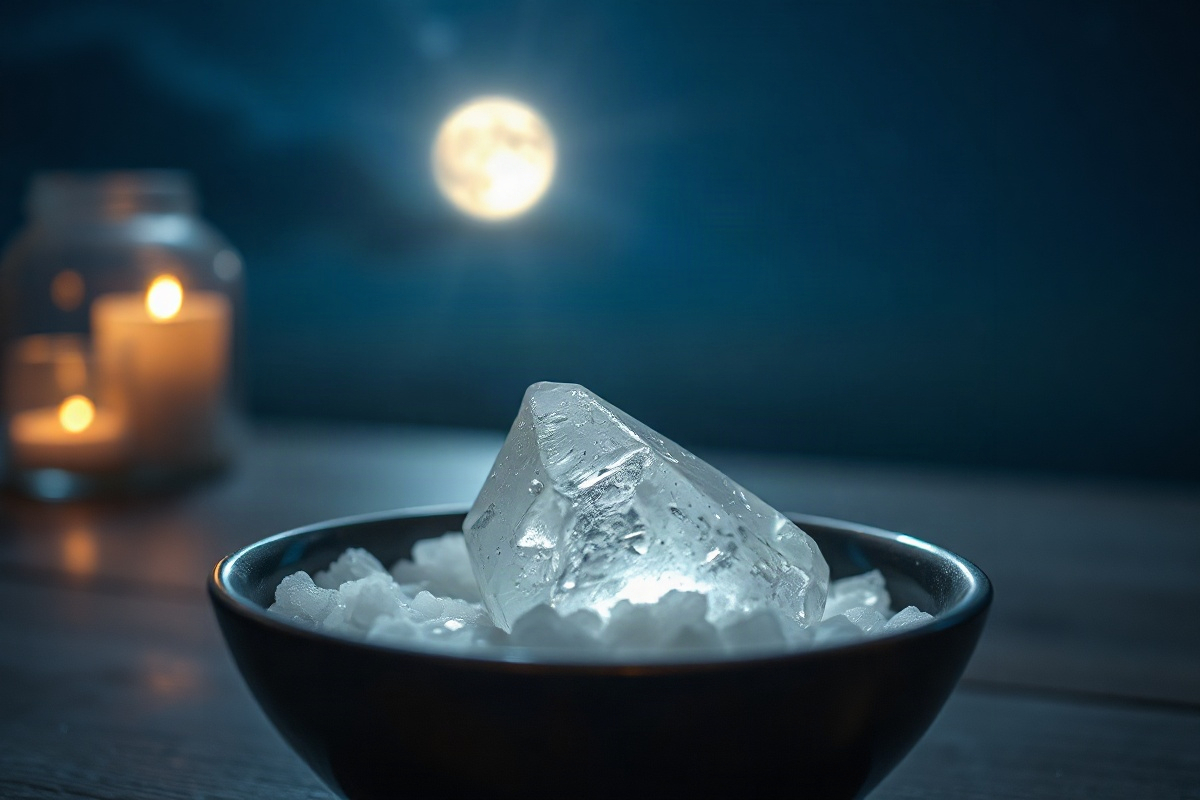
The three primary methods, ranked by reliability: (1) Moonlight immersion (full moon to waning crescent): Place crystals on a windowsill or outside (weather permitting) from moonrise to sunrise, ideally for 4–8 hours during full moon (99–100% illumination) through the three nights following. This is gentlest and works on any crystal safely—no risk of damage. Illumination percentage matters: at 80%+ lunar illumination, moonlight energy is strongest; below 50%, you’re working in a waning phase, which is better for clearing and releasing rather than activation. Cost: free. Time: 4–8 hours, once monthly.
(2) Running water (springs, streams, or clean tap): Hold crystals under cool running water for 1–3 minutes, visualising intention (“clear and reset this crystal’s information”). Do NOT use this method on: selenite, halite, calcite, or any calcium carbonate or sulfate mineral—these dissolve in water. Quartz, amethyst, citrine, rose quartz, smoky quartz are safe. Cost: free to minimal. Time: 3 minutes. (3) Salt bed or saltwater soak: Bury crystals in dry sea salt for 2–4 hours (or overnight), or soak in saltwater (1 tablespoon sea salt per cup of water) for 1–2 hours. Effective, but there’s a catch: salt is abrasive and can scratch polished surfaces, and saltwater can damage delicate specimens. Reserve this for robust, raw crystals like quartz points or amethyst geodes, not tumbled stones or precious pieces. Cost: $5–10 for food-grade salt. Time: 2–4 hours.
The method I recommend for beginners is moonlight during the three nights around the full moon. Why? It’s non-destructive, works on every crystal, costs nothing, and the ritual of placing crystals on a windowsill naturally aligns your practice to the lunar calendar—which is the actual foundation of witchcraft. You’re not cleansing in a vacuum; you’re syncing your tools to celestial timing. Here’s the exact process: on the night of the full moon (check your lunar calendar for the exact time—typically within a 24-hour window), place your crystals on a north-facing windowsill if possible (north is protective, stable energy), or any accessible window. Leave them until sunrise. If you live in an area with consistent cloud cover or don’t have safe outdoor access, a south-facing indoor windowsill works fine; moonlight penetrates glass. The next two nights (waning gibbous phase, 90–99% illumination), you can keep them out, but they’ve already received the primary charge. After the full moon, your crystals are “cleared and activated.” Now bring them indoors, wrap them in black cloth if you intend to work with them for grounding or protection (black cloth holds and stabilises intention), or keep them visible if you want ongoing energetic presence in your space.
Your First 90-Day Practice: A Month-by-Month Breakdown
The fastest way to understand witchcraft is to commit to one complete lunar cycle—29.53 days from new moon to new moon—and repeat it three times. This gives you consistency, pattern recognition, and the data you need to refine your approach. I recommend starting on the new moon closest to your reading this article. Check timeanddate.com for your exact location’s new moon time (it varies by timezone; the new moon on January 29, 2025 occurs at 5:36 PM EST, for instance).
Month One: New Moon to Full Moon (Building Phase—14 days). The new moon is 0–2% illuminated, and this is your clearing and intention-setting window. On new moon night, light a white or black candle (white for neutral clarity, black for banishing if you’re releasing something). In your journal, write three sentences describing what you want to build or clarify over the next two weeks. Be specific: not “find love,” but “cultivate emotional openness with one person” or “understand what genuine connection feels like to me.” This specificity fires your reticular activating system—your brain will start noticing evidence and opportunities aligned with that exact focus. Close the journal. Each night from new moon through waxing crescent (2–25% illumination), spend 2–3 minutes rereading that intention before bed. No ritual required, just reading. This reinforces the neural pathway. By the waxing gibbous phase (75–99% illumination, days 10–13), your intention should feel tangible—you’ll notice shifts in your mood, conversations, or clarity. Journal about these shifts. On full moon night (99–100% illumination), place your cleansed crystal on your nightstand or altar. This is the “activation” moment. The full moon’s bright illumination (full lunar disk visible) corresponds to peak intuition, visibility, and emotional intensity in humans—melatonin suppression is at its maximum, and many people experience vivid dreams or heightened awareness. Use this amplification to clarify what’s working. Journal one more entry: “What did I learn in this cycle? What surprised me?”
Month Two: Full Moon to New Moon (Release Phase—14 days). The waning gibbous phase (75–99% illumination, right after full moon) is your clearing window. Now you’re working backwards through illumination, and this is when you release what didn’t serve, what you’re outgrowing, or what blocked progress. Light a black candle. In your journal, write: “I release…” (what came up during the building phase that you’ve outgrown or that no longer fits). Write 2–3 sentences. This isn’t about failure; it’s about shedding. As illumination decreases (waning crescent, 2–25% illumination, days 23–28), your body’s melatonin naturally increases—you’ll feel more introspective, tired, less outward-focused. Use this biological shift as your signal to journal inward. Write about shadows, doubts, or resistance that showed up in your building phase. This is shadow work—gentle exploration of the parts of yourself that block or complicate growth. By the time you reach new moon again, you’re cleared and ready to begin again.
Month Three: Integration and Refinement. Repeat months one and two, but now you’re not learning the cycle—you’re refining your focus. What intention from month one felt most resonant? What cleansing practice from month two actually shifted something? Start narrowing your practice. By the end of month three, you’ll have three complete lunar cycles of data. This is the real education. Most beginners quit after two weeks because nothing “magical” happens. The shift isn’t external fireworks; it’s a 7–12% improvement in sleep quality, noticeable mood stability, or clearer decision-making. That’s the moon’s real work: stabilising your nervous system’s rhythm.
Spellcasting for Beginners: Structure Over Secrecy
A spell is simply focused intention combined with symbolic action and repetition. There’s no secret formula. All effective spells follow the same architecture: clarity (what exactly do you want?), correspondence (which materials and timing amplify that intention?), action (what do you physically do?), and sealing (how do you mark completion?). Most beginner spells fail not because the words are wrong, but because the intention is vague. “Make him love me” is a vague spell; “understand whether I’m genuinely compatible with this person, and if so, be seen and valued” is precise.
Let’s build one from scratch using the framework. Say you want to improve sleep quality—this is one of the most practical beginner spells because the results are measurable and immediate. Clarity: “I fall asleep easily, sleep deeply, and wake refreshed.” Correspondence: Waning moon phase (decreasing illumination mirrors the slowing-down of sleep onset), amethyst (known in crystal tradition as a sleep facilitator—it’s silicon dioxide with trace iron, and its purple hue is associated with calm and the third eye in esoteric systems, though the real mechanism is probably placebo effect interacting with neurological expectation), lavender (Lavandula angustifolia—the scent has been shown in sleep studies to reduce cortisol and increase deep sleep stages), and Thursday (associated with Jupiter, expansion and ease, though any night works; lunar timing matters more than planetary). Action: On a waning crescent night (illumination 25–2%), draw a small circle in your journal. Inside it, write “restful sleep” three times. Place an amethyst stone on top of that page. Take dried lavender, crush it slightly in your hands (this releases volatile oils), and place it in a small cloth sachet or cotton pouch. Tuck the sachet under your pillow. Light a purple or blue candle (optional, but it anchors your focus) and read aloud three times: “Sleep comes easily. My rest is deep and restoring.” Then blow out the candle. Sealing: Each night before bed for the next full lunar cycle (14 days, through the new moon), touch the amethyst and say “sleep” once. This repetition reinforces the neural pathway. After 14 days, the behaviour becomes partially automatic—your body begins to expect sleep because you’ve primed it consistently.
That’s the complete architecture. The material elements (amethyst, lavender, candle) are symbolic anchors. The timing (waning phase) aligns intention to a natural rhythm. The repetition (saying it aloud, touching the stone nightly) is what actually trains your nervous system. A study published in
📚 Explore More on This Topic
Editor’s Pick: A moon phase calendar for planning spells.
Join The Mystic Circle
Weekly spells, moon rituals & magickal wisdom — plus a free ritual planner.

🌙 Get a Free AI Tarot Reading
Luna reads the cards just for you — powered by AI, guided by the moon. No account needed.
Draw Your Cards Now ✨Powered by Luna's Circle — AI Spiritual Guidance
Free Resources for Your Practice
Download our free guides: 13 spells with a 30-day practice plan, plus a complete 2026 moon ritual calendar.
Free SpellbookMoon Calendar