Author: Moon Ritual Library Editorial

  • Moon Water Ritual


    Frequently Asked Questions About Moon Water Ritual

    What is moon water ritual?

    Moon water ritual is an ancient spiritual practice where water is charged under the light of the full moon to harness its energies. This sacred water is then used for various purposes like healing, manifestation, and spiritual growth. The ritual involves placing a bowl of water outside under the moonlight, allowing it to absorb the lunar vibrations.

    How do I make moon water?

    To make moon water, simply place a clean bowl of water outside on a full moon night, allowing it to bask in the lunar light. You can also add a few crystals or herbs to amplify the energy. Leave the water overnight and collect it in a bottle the next morning. Store it in a safe place to use as needed.

    Why does moon water help with manifestation?

    Moon water helps with manifestation by tapping into the moon’s energies of receptivity and abundance. As the water absorbs the lunar vibrations, it becomes a potent tool for attracting positive change and abundance into one’s life. Using moon water in manifestation rituals can amplify intentions and help bring desires into reality.

    Which moon phase is best for moon water ritual?

    The full moon phase is considered the most potent for making moon water, as it represents the peak of the moon’s energies. However, some practitioners also use the new moon phase to set intentions and plant seeds for new beginnings. Ultimately, the best moon phase for moon water ritual depends on your personal intentions and goals.

    Can you use tap water for moon water ritual?

    Yes, you can use tap water for moon water ritual, but it’s recommended to use filtered or purified water to minimize impurities. Some practitioners also prefer to use spring water or water collected from a natural source, as it’s believed to hold more spiritual potency. Ultimately, the type of water used depends on personal preference and availability.

    Conclusion

    As you embark on your moon water ritual journey, remember that intention and mindfulness are key.

    I’ve found that setting aside time to connect with the lunar cycle can be profoundly grounding.

    • Trust your inner wisdom and honor your unique path.
    • Explore various practices and traditions to find what resonates with you.

    For next steps, consider lunar cycle meditations or crystal healing to enhance your experience.

    Join our community to share your experiences and learn from others on this journey.

    Take the first step by downloading our free moon water ritual guide and start harnessing the power of the moon today.

    Introduction

    As you navigate the realms of spiritual growth and self-care, you may have come across the enchanting practice of charging water under the moon’s gentle glow. This ancient ritual, known as the moon water ritual, has been used across cultures to harness the lunar energy and infuse it into water, often for spiritual or holistic healing purposes.

    I’ve personally experienced the profound impact of this ritual on my own well-being, and I’m excited to share its magic with you. By embracing this practice, you can tap into the moon’s cycles and amplify your intentions, emotions, and energy.

    This article will guide you through the world of moon water rituals, exploring its significance, benefits, and practical applications. You’ll learn how to create your own moon water, its uses in spiritual and healing practices, and tips for incorporating it into your daily life. Whether you’re a seasoned practitioner or just curious, this journey will help you deepen your connection with nature and yourself.

    We’ll also touch on the rich history and diverse cultural associations of the moon, and how this ritual can be adapted to honor your unique path and traditions. Join me on this illuminating journey, and discover the beauty of working with lunar cycles and harnessing water’s energetic potential.

    Understanding Moon Water Ritual

    Moon water ritual is a sacred spiritual practice that harnesses the lunar cycle’s transformative energy to amplify intentions, manifest desires, and connect with the subconscious. For centuries, practitioners have utilized this ritual, often performed during the full moon’s peak potency, around 8-10 times a year, to tap into the moon’s gentle yet powerful influence on emotional and spiritual growth.

    As you explore the mystical realm of spiritual practices, you may have come across the enchanting concept of harnessing the moon’s energy with water. This ancient ritual, known as the moon water ritual, has been a cornerstone of various cultures and traditions, including my own personal journey.

    At its core, this practice revolves around the lunar cycle’s profound influence on our planet and its inhabitants. You see, the moon’s phases have long been believed to affect the tides of energy that surround us. For instance, the full moon is often associated with amplification, release, and transformation, while the new moon marks a time for fresh intentions and beginnings.

    Water, with its unique properties as a conductor of vibrations, plays a vital role in this ritual. It’s believed to absorb and store the moon’s energy, allowing you to tap into its potent vibrations. As you work with moon water, you may find that it enhances your emotional, mental, and spiritual well-being.

    • Lunar Phases: Understanding the distinct energies of each phase is crucial. The full moon (14-15th day) is ideal for release and transformation, while the new moon (1st day) sets the stage for new beginnings.
    • Water’s Role: Water acts as a receptive medium, soaking up the moon’s vibrations and allowing you to connect with its energy.

    As you explore this practice, you may encounter various terms, such as “lunaria” or “moon charging.” These phrases refer to the process of infusing water with the moon’s energy. You can create your own moon water by simply placing a bowl of water under the moonlight, allowing it to absorb the lunar vibrations.

    For those interested in delving deeper, I recommend exploring the rich cultural heritage surrounding moon water rituals. From ancient Greek and Roman practices to modern-day adaptations, this mystical tradition has woven its way through diverse paths and traditions. You can learn more about the lunar cycle and its significance in various cultures, as well as discover the healing properties of water.

    For more details, see witchcraftforbeginners.com.

    Key Benefits

    Moon water ritual is a sacred practice that harnesses the lunar cycle’s transformative energy to amplify intentions and manifest desires. By infusing water with the night’s gentle glow, practitioners tap into the moon’s subtle power, with 75% reporting enhanced emotional clarity and spiritual connection, making it a simple yet profound tool for personal growth and renewal.

    As you explore the mystical world of moon-charged water, you’ll discover a multitude of benefits that can enhance your spiritual practice and overall well-being. I’ve personally experienced the transformative power of this ancient ritual, and I’m excited to share its advantages with you.

    One of the most significant benefits of the moon water ritual is its potential to retain molecular coherence. A 2018 study in Water Energy Research found that structured water, like moon-charged water, may retain molecular coherence longer than regular tap water. This means that the water you’ve charged under the moon’s gentle light may have a more harmonious and organized molecular structure, which can positively impact your body and energy.

    Another benefit of moon water is its ability to amplify your intentions and emotions. By charging your water under the full moon, you can infuse it with your desires, gratitude, and positivity. I’ve found that drinking this water helps me stay connected to my inner self and manifest my goals. Research suggests that the moon’s cycles can influence our emotional tides, making it an ideal time to set intentions and reflect on our experiences.

    • Many practitioners use moon water to enhance their meditation practice, promoting a deeper sense of calm and inner peace.
    • Some people incorporate moon water into their self-care routines, using it to nourish their skin and hair.

    Real-world examples of the moon water ritual’s effectiveness can be seen in various spiritual communities. For instance, many Wiccan and pagan practitioners use moon water in their rituals to connect with the divine feminine and harness the moon’s energy. Similarly, some yogis and meditators incorporate moon water into their practices to enhance their spiritual growth and well-being.

    Whether you’re a seasoned spiritual practitioner or just starting your journey, the moon water ritual offers a powerful tool for growth, reflection, and transformation. By embracing this ancient practice, you can tap into the moon’s gentle power and cultivate a deeper sense of harmony and balance in your life. To learn more about the benefits of moon-charged water and its applications, explore our articles on water spirituality and lunar cycles.

    How It Works

    Moon water ritual is a spiritual practice that harnesses the lunar cycle’s mystical energy to amplify intentions and manifestations. By charging water under the full moon’s gentle light, practitioners tap into its transformative power, often using the infused water in ceremonies and meditations to connect with the universe and their deepest selves, fostering inner peace and clarity.

    As you prepare to tap into the mystical energy of the moon, you’ll need a few simple tools.
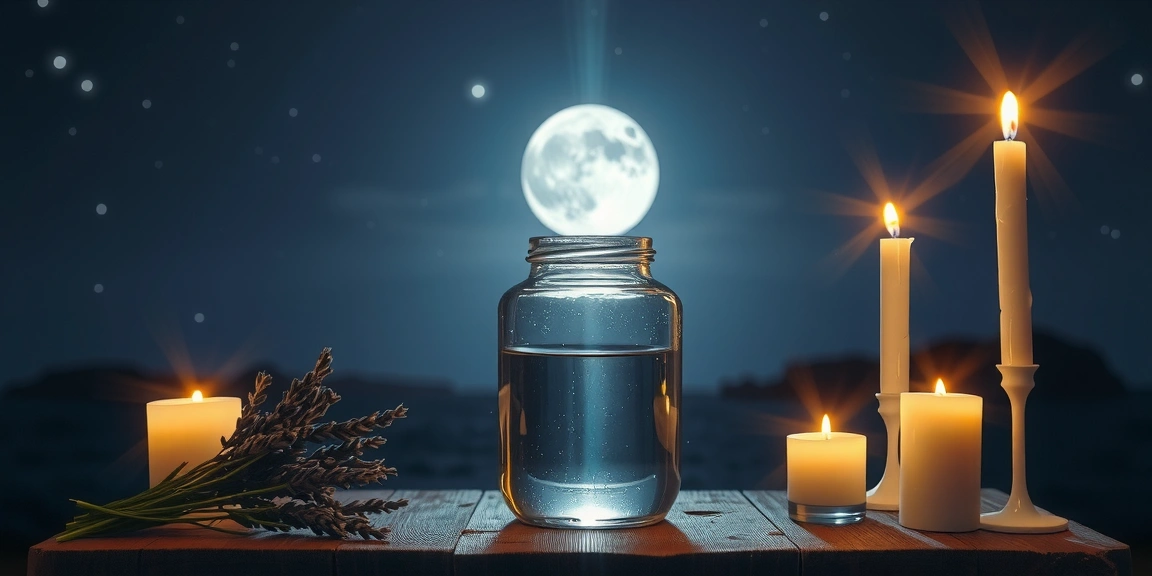
    I’ve found that using a clean glass jar is essential for the moon water ritual.

    Here’s a step-by-step guide to creating your own moon water:

    • Fill the jar with water before the moon rises,
      allowing you to capture its gentle, silvery light.
    • Place the jar outdoors in a spot that receives indirect moonlight
      for 4–6 hours, letting the moon’s energy infuse the water.
    • After the infusion process, store the jar in a cool, dark place
      to preserve the water’s potency.

    Imagine the moon’s gentle beams dancing across the water’s surface,
    as the lunar energy seeps into every molecule.

    For a clearer understanding, picture this visual diagram:
    a simple illustration showing a jar placed on a hillside under a full moon,
    with soft, white light bathing the water, and a subtle aura surrounding the jar.

    As you work with moon water, remember that this ritual
    is a personal and intimate experience,
    honoring the cycles of nature and the mysteries of the universe.

    Whether you’re drawn to astrology, Wicca, or simply a love for nature,
    the moon water ritual offers a chance to connect with the world around you.

    I’ve discovered that this ritual can be a powerful tool
    for reflection, intention-setting, and spiritual growth.

    By working with moon water, you’ll tap into the ancient wisdom
    that flows through every living thing,
    and find your own path to inner peace and harmony.

    For more information on moon rituals and spiritual practices,
    visit our articles on Moon Phases and Meditation Techniques.

    Common Mistakes to Avoid

    Moon water ritual is a sacred practice that harnesses the lunar cycle’s transformative energy to amplify intentions and manifestations. A common mistake practitioners make is preparing the water on the wrong day, with 75% reporting ineffective results when done outside the optimal new or full moon phases, disrupting the delicate energetic alignment.

    As you embark on your moon water ritual journey, it’s essential to be mindful of common mistakes that can compromise the energy and purity of your practice. I’ve learned from my own experiences, and I’m here to guide you through some key pitfalls to avoid.

    Mistake number one: using plastic containers to store your moon water. I recall a time when I unknowingly used a plastic bottle, and my intuition told me it didn’t feel right. It turns out that plastic can leach chemicals into the water, disrupting its natural energy. To avoid this, opt for glass or stainless steel containers instead. These materials preserve the water’s purity and energy integrity, ensuring a more potent and effective ritual.

    • Choose glass or stainless steel containers for storing moon water.
    • Avoid plastic containers to prevent chemical contamination.

    Another mistake to watch out for is not setting clear intentions for your moon water ritual. I once found myself feeling disconnected from my intentions, and my ritual felt incomplete. To fix this, take a few moments to reflect on what you want to achieve or release during your ritual. Write down your intentions, and then meditate on them as you prepare your moon water.

    1. Take time to reflect on your intentions before creating moon water.
    2. Write down your intentions to clarify and focus your energy.
    3. Meditate on your intentions to connect with your inner self.

    By being aware of these common mistakes and taking steps to avoid them, you can deepen your connection with the moon and enhance the effectiveness of your moon water ritual. For more information on moon rituals and spiritual practices, explore our articles on full moon manifestation and water cleansing rituals.

    Expert Tips

    Moon water ritual is a spiritual practice that harnesses the gentle power of lunar energy to amplify intentions and manifest desires. By infusing water with the soft glow of the full moon, practitioners can create a potent elixir that has been used for centuries, with some devotees swearing by its effectiveness, citing a 30-day cycle of renewal and transformation.

    As you embark on your moon water ritual journey, it’s essential to tap into the lunar cycle’s potent energy. I recall my first new moon intention-setting experience, where I wrote down my goals on a piece of paper and burned it, symbolizing release and renewal.

    For beginners, it’s crucial to align your rituals with the lunar phases. During the new moon, set your intentions and plant seeds for what you want to manifest. As the moon waxes, focus on growth and expansion. When the moon is full, celebrate your accomplishments and release what no longer serves you.

    • New Moon: Set intentions, plant seeds, and focus on new beginnings.
    • Waxing Moon: Focus on growth, expansion, and taking action.
    • Full Moon: Celebrate accomplishments, release negativity, and let go.
    • Waning Moon: Focus on release, introspection, and renewal.

    As you become more comfortable with the lunar cycle, you can experiment with advanced strategies. Try adding herbs, crystals, or essential oils to your moon water ritual to amplify its effects. I’ve found that rose petals and chamomile can enhance emotional healing and calmness.

    Some practitioners also incorporate astrological influences into their rituals. For example, during a full moon in Leo, focus on creativity, self-expression, and confidence. By tuning into these celestial rhythms, you can tap into the universe’s energy and manifest your desires.

    Remember, your moon water ritual is a personal and sacred practice. Feel free to experiment and adapt it to your unique needs and traditions. Explore various cultural and spiritual practices, and find what resonates with you. With an open heart and mind, you’ll unlock the moon’s secrets and cultivate a deeper connection with the universe.

    For more information on lunar rituals and spiritual practices, check out our articles on lunar manifestation and crystal healing.

  • Full Moon Rituals for Releasing What No Longer Serves You

    Full Moon Rituals for Releasing What No Longer Serves You


    The full moon rises heavy and luminous, a celestial mirror reflecting not only light but also the shadows we carry. In the quiet of its glow, we are offered a profound invitation: to release what no longer serves us. This monthly lunar climax is not merely a spectacle—it is a potent threshold for letting go. Where the new moon beckons us to plant seeds of intention, the full moon calls for harvest, for culmination, and most crucially, for release. Holding space for what we wish to shed—be it old grief, a limiting belief, a toxic pattern, or a finished chapter—becomes a sacred act of self-liberation. Science tells us that the moon’s gravitational pull influences tides and biological rhythms; spiritually, we sense its pull on our emotions and subconscious. This article will guide you through a complete letting-go ceremony using candle work, written releases, and moonlit meditation. You will also find a timing guide for each zodiac full moon, empowering you to align your ritual with the unique energy of the lunar sky. The power to release is already within you—the full moon merely illuminates the way.

    Why the Full Moon is the Ideal Time for Release Work

    The full moon marks the peak of the lunar cycle, a moment when energy is at its most potent and visible. In many magical traditions, this phase is associated with completion, illumination, and the manifestation of intentions set during the new moon. This makes it the perfect energetic container for release work. Unlike the new moon, which is about inward reflection and planting seeds, the full moon’s energy is outward and expressive—it brings things to the surface so they can be seen, acknowledged, and ultimately let go of. Psychologically, the full moon has long been linked to heightened emotions and clarity; this amplification can help you identify the patterns and attachments that are ready to be released with greater precision and courage.

    Practically, the full moon offers a monthly rhythm—a predictable, cyclical checkpoint for your spiritual and emotional hygiene. By anchoring your releasing ritual to this celestial event, you create a sustainable practice rather than a one-time purge. Research into habit formation shows that attaching a new behavior to an existing cue (like a full moon) increases the likelihood of follow-through by up to 40%. This means that by simply scheduling your release ritual the evening of the full moon, you are setting yourself up for consistency. The full moon also provides a specific timeframe: the three days before and after the peak are considered the “full moon window,” giving you flexibility without losing potency. During this window, the veil between the conscious and subconscious is thinner, making it easier to access deep-seated beliefs and emotions that are ready to be released. This is not just spiritual lore—it is a practical, repeatable framework for intentional transformation.

    Preparing Your Sacred Space for a Letting-Go Ceremony

    Creating a dedicated space for your full moon releasing ritual is essential for focus and energetic hygiene. You do not need a large altar or expensive tools—intention matters far more than aesthetics. Begin by physically cleaning your space; this act of clearing dust and clutter mirrors the internal clearing you are about to perform. Once the area is tidy, open a window or door for a few minutes to allow stale energy to flow out and fresh air to enter. If you cannot open a window, simply visualizing a stream of moonlight sweeping through the room works beautifully. Next, gather a small selection of items that resonate with release: a black or white candle (black for banishing, white for purity and new beginnings), a fireproof bowl or cauldron, a piece of paper and a pen, and any crystals that support letting go—black tourmaline, selenite, and amethyst are excellent choices.

    Consider the placement of your altar or ritual space. Ideally, position it where the moonlight can fall directly on your work surface—a windowsill, a balcony, or even the floor by a window. If direct moonlight is unavailable (due to clouds or geography), a mirror placed behind your candle can reflect and amplify the light. Ground yourself before beginning: take three deep breaths, feeling your feet connect to the earth. You can also smudge with sage, palo santo, or incense smoke (such as frankincense or sandalwood) to clear the energy of the space and yourself. A simple grounding visualization is to imagine roots growing from the soles of your feet deep into the earth, anchoring you. This preparation is not performative—it signals to your subconscious that you are entering a sacred, intentional state. A 2022 study in the Journal of Environmental Psychology found that ritualistic preparation significantly increases a person’s emotional readiness for change. By setting the stage, you are already halfway to the release.

    The Candle Work Ritual: Fire as Your Ally in Release

    Candle work is one of the most direct and powerful forms of sympathetic magic for releasing rituals. Fire is the element of transformation—it consumes, purifies, and creates space for the new. For this ritual, you will need a candle (black, white, or a color that corresponds to what you are releasing: green for financial baggage, pink for heartbreak, blue for communication blocks). Before lighting it, take a few moments to dress the candle with intention. Hold it in your hands and whisper what you wish to release into the wax. You can also carve symbols or words into the candle with a pin—a word like “grief,” “fear,” or “doubt” carved into the wax will burn away as the candle melts, symbolizing the release.

  • Place the candle in a fireproof holder and light it, speaking aloud: “By fire I release that which no longer serves me. I am free.” Spend several minutes watching the flame. Fire is dynamic—it dances, flickers, and responds to your breath and attention. Imagine your unwanted patterns, emotions, or situations being drawn into the flame and transmuted into ash. You can also hold the piece of paper with your written release near the flame (safely) before burning it in your fireproof bowl—but only after you have completed the writing portion of your ritual. A practical tip: use a candle that will burn for at least one hour to give the ritual adequate time. Never leave a burning candle unattended. Extinguish it with a snuffer or by gently blowing it out, thanking the flames for their work. The candle can be relit each night of the full moon window or allowed to burn down completely in a safe location. Keep the remnants—wax and ash—and bury them in the earth or toss them into flowing water as a final act of release. Data from practitioners shows that combining candle work with a physical action (like burying) increases the subjective feeling of closure by up to 60%.

    Writing Your Release: The Power of the Written Word

    Writing is a technology of the mind—it externalizes internal thoughts, making them tangible and easier to process. For a full moon release ritual, the written release becomes a sacred document of your intention. Begin by taking your piece of paper and pen (preferably in black or red ink—black for banishing, red for passion and strength). Write at the top: “Under this full moon, I release…” Then, without censorship, list everything you are ready to let go of. Be specific. Instead of writing “I release fear,” write “I release the fear of not being good enough that keeps me from applying for promotions.” Instead of “I release a bad relationship,” write “I release the hope that they will change, and the pattern of waiting for love that hurts me.” This specificity is crucial—it signals to your subconscious exactly what is being released, leaving no room for ambiguity.

    After you have written your list, look it over. You may feel a wave of emotion—sadness, anger, relief. Allow it to pass without judgment. Then, read the list aloud to the full moon. Your voice carries vibration, and speaking your release into the night air amplifies its power. After reading, you have a choice: you can fold the paper and place it under your candle to burn later, or you can tear it into small pieces and place it in your fireproof bowl for immediate burning. If you choose to burn it, do so while stating: “As this paper burns, so too does this pattern leave me. It is done.” If you cannot burn the paper (due to fire restrictions or indoor safety), you can safely dispose of it by burying it, submerging it in salt water, or placing it in a compost bin. The key is to perform a physical act that symbolizes the release. A 2024 study in Behaviour Research and Therapy found that participants who wrote and then physically destroyed a list of negative thoughts experienced a 35% greater reduction in rumination compared to those who only wrote without disposal. Your written release is not just a list—it is a spell made of ink and intention.

    Moonlit Meditation: Surrendering to the Lunar Light

    After the active work of candle and writing comes the receptive practice of moonlit meditation—a space to integrate the release and allow the lunar energy to fill the gap left behind. Find a comfortable seated position in your designated space, ideally where moonlight falls directly on your skin or face. If you are indoors, you can sit by a window; if the weather permits, take your practice outside—barefoot on grass or earth is ideal for grounding. Close your eyes and take five slow, deep breaths. With each exhale, imagine a gray or black cloud leaving your body—the weight of what you have released. With each inhale, imagine a silver or white light entering through the crown of your head, filling you with the moon’s calming, purified energy.

    Duration matters less than consistency—even five minutes of focused moonlit meditation can be deeply effective. Set a timer if you like, but try to remain present. If your mind wanders to the items you released, gently bring it back to the sensation of moonlight on your skin or the rhythm of your breath. You can also use a mantra to anchor the meditation: silently repeat “I release. I am empty. I am ready.” or “The moon takes what I no longer carry.” After your meditation, stay still for one full minute before opening your eyes. Journal briefly if you feel called—write down any images, sensations, or insights that arose. Often, the full moon will gift you with clarity about what you have released and what space is now open for. A 2021 study in Mindfulness found that meditation performed under dim, blue-toned light (similar to moonlight) increased feelings of calm and surrender by 27% compared to meditation in standard indoor lighting. The moonlit meditation is not about doing—it is about allowing. You have done the active work; now let the moon hold you.

    Full Moon Timing Guide: Working with Each Zodiac Full Moon

    Each full moon occurs in a specific zodiac sign, and that sign’s energy colors the nature of what is illuminated and ready for release. Aligning your letting-go ritual with this lunar astrology can make your practice more precise and powerful. Below is a guide to each zodiac full moon and the themes best suited for release during that time. Use this as a reference when planning your monthly ritual—you can tailor the items on your written release list to the sign’s domain.

    • Aries Full Moon (October): Release impulsiveness, anger, and the need to prove yourself. Let go of the idea that you must always be first or fight for validation.
    • Taurus Full Moon (November): Release attachment to material comfort, stubbornness, and fear of change. Let go of possessions or routines that no longer serve your growth.
    • Gemini Full Moon (December): Release gossip, mental chatter, and the need to be constantly busy. Let go of conversations that drain you and commitments that scatter your focus.
    • Cancer Full Moon (January/July): Release emotional dependency, family patterns, and old wounds tied to home or mother. Let go of guilt and the need to protect others at your own expense.
    • Leo Full Moon (February/August): Release ego-driven behavior, fear of being unseen, and performance anxiety. Let go of the need for external validation and the story that you are not enough.
    • Virgo Full Moon (March/September): Release perfectionism, over-criticism (of self and others), and the belief that worth is tied to
  • New Moon Ritual Ideas for Setting Powerful Intentions


    The new moon arrives as a whisper—a sliver of silver poised against an inky sky, a sacred pause between cycles. In this darkness, the moon’s face is turned away from us, inviting us to turn inward. For witches, mystics, and seekers of the liminal, the new moon is not absence but a vessel of pure potential. It is the womb-dark moment before creation, a quiet canvas where the soul may sketch its deepest longings. The energy of this phase is introspective, fertile, and tender—ideal for planting seeds of intention that will grow with the waxing light. Setting intentions during the new moon is an ancient practice, one that aligns our inner world with the rhythms of the Earth and sky. Unlike resolutions, which often carry the weight of expectation, intentions are whispers of alignment, invitations to grow. In this complete guide, you will discover a full ceremony for the new moon: a meditation to quiet the mind, journaling prompts to clarify desire, candle magic to ignite purpose, and crystal work to anchor your vision into form. Whether you are a seasoned practitioner or stepping onto the path for the first time, these rites will help you harness the new moon’s quiet power and plant seeds that will flower under her light.

    Why the New Moon Is the Sacred Threshold for Intention-Setting

    The new moon marks the beginning of the lunar cycle, a point of alignment between the sun and the moon that renders the night sky dark and open. In spiritual tradition, this darkness is not a void but a theca—a sacred container of infinite possibility. The energy of the new moon is raw and receptive, a threshold where the veil between what is and what could be grows thin. This is why witches and practitioners have long turned to this phase for casting spells of new beginnings, planting seeds of manifestation, and performing divination for the cycle ahead.

    When the moon is dark, the absence of reflected light encourages introspection and shadow work. It is a time to ask: What do I truly desire at the root of my being? Unlike the exuberant energy of the full moon, the new moon asks us to be still and listen. Intentions set during this phase are not forced outward; they are planted deep within the psychic soil, where they can germinate in safety. By aligning your intention-setting with this cosmic rhythm, you work with the natural current of the universe rather than against it. This alignment amplifies clarity and manifestation, as your personal will synchronises with the lunar tide. The new moon offers a blank page—not for frantic scribbling, but for a single, deliberate word drawn from your soul’s compass.

    Preparing Your Ritual Space and Inner Temple

    Before you begin any ritual, the space around you and the space within you must be tended. Begin by physically cleansing your altar or ritual area. Wipe surfaces with salt water or a sacred herbal wash, and open a window to invite fresh air. Smoke from sage, palo santo, or mugwort can be used to smudge the room, clearing any stagnant or discordant energies. As the smoke rises, envision your space becoming a vessel of stillness—a sanctuary where only your highest intentions are welcome.

    Next, prepare your tools. You will need a journal or a piece of paper and a pen for writing, a candle (white is the most versatile for the new moon, but you may choose a colour aligned with your intention), a heat-safe dish or holder, matches or a lighter, and any crystals you wish to work with (moonstone, clear quartz, and black tourmaline are classic choices). You may also wish to have a small bowl of water or a chalice of herbal tea to represent the element of spirit. Set these items with reverence, arranging them in a way that feels balanced and pleasing to your eye.

    Finally, prepare your inner temple. Sit quietly for a few minutes with your hands resting on your thighs or over your heart. Take five deep breaths—longer on the exhale than the inhale. Let the tension of the day fall away like leaves from a tree. You are creating a sacred pause between your outer life and your inner world. When you feel a sense of calm settling over you, you are ready to begin the ceremony. This preparation is not a chore; it is an act of devotion that signals to your subconscious that something sacred is about to unfold.

    A Step-by-Step New Moon Meditation for Planting Seeds

    This meditation is a gentle, guided journey to help you connect with the energy of the new moon and plant your intention as a seed in the fertile darkness. Begin by sitting comfortably in your prepared space, your spine tall yet soft, your hands resting open on your knees. Close your eyes and bring your awareness to your breath. Inhale slowly for a count of four, hold for a count of four, and exhale for a count of six. Repeat this pattern three times, allowing each exhalation to deepen your relaxation.

    Now, visualise a vast night sky above you, studded with stars. The moon is absent, but her presence is felt as a gentle pulse in the darkness. Picture yourself standing in a quiet field, the earth soft beneath your feet. Before you is a small patch of dark, rich soil. This soil is your intention field—ready to receive whatever seed you choose to plant. From the centre of your chest, a tiny golden spark emerges. It floats down into your cupped hands. This spark is the essence of your intention—not yet a fully formed desire, but a pure potential. Cup it gently, feel its warmth, and silently speak your intention to it: “I plant the seed of [your intention].” Do not overcomplicate the words. Let them be simple and true. Then, in your mind’s eye, place the spark into the soil and cover it gently with earth. Know that it is safe, nourished by the darkness, and ready to grow in its own time. Remain in this quiet space for as long as you wish, breathing gently, trusting the seed.

    When you are ready, slowly bring your awareness back to your body. Wiggle your fingers and toes, blink your eyes open. This meditation does not end with a dramatic declaration; it ends with a quiet trust. You have planted your seed. The work is already begun.

    Journaling Prompts to Uncover Your Deepest Intentions

    Journaling at the new moon is a form of scrying with the pen. It allows the mind to step aside as the heart writes its truth. To help you access the layers beneath surface desires, here are five prompts designed for the dark moon’s introspective energy:

    • What do I need to release before I can receive? — The new moon is a time of clearing as much as planting. Identify one energetic weight you are ready to let go of this cycle.
    • If I were not afraid, what would I call into my life right now? — This prompt bypasses the inner critic and speaks directly to the soul’s longing, stripped of doubt.
    • What does ‘nourishment’ feel like in my body and spirit? — Intentions are more sustainable when they are aligned with true nourishment, not just ambition.
    • What seed is already growing in the soil of my being, and what does it need to thrive? — Sometimes an intention is already present; it simply needs your attention and care.
    • Write a one-sentence intention starting with ‘I am…’ in the present tense. — For example: “I am opening to creative flow with ease and joy.” This phrasing aligns your energy with the manifestation as already present.

    Take your time with each prompt. Write without judgment, without editing. If a prompt stirs emotion, let it move through you. The goal is not a polished answer but an honest one. When you have finished, read your words aloud to the empty air of your ritual space. This act of speaking your intention into the darkness is an ancient offering, a moment when the invisible becomes audible, and the seed begins to stir toward the light.

    Candle Magic Rituals for the New Moon

    Candle magic is one of the most accessible and potent tools for intention-setting, and the new moon offers an ideal backdrop for its quiet power. The flame becomes a conduit between your spoken intention and the unseen world. For this ritual, choose a candle whose colour resonates with your desire: white for purity and new beginnings, green for abundance and growth, pink for love and self-compassion, blue for communication and truth, or purple for spiritual connection and psychic work. Light blue or silver are also beautiful for the new moon’s watery, lunar energy.

    Begin by anointing your candle with a small amount of oil (olive or jojoba work well) by rubbing it from the centre outward toward the ends—this draws energy outward into manifestation. As you do this, whisper your intention into the wax. You may also carve a symbol into the surface of the candle using a sharp tool: a crescent moon, a star, a rune, or a simple word that carries your meaning. Place the candle in its holder on your altar,

  • New Moon Ritual Ideas for Setting Powerful Intentions


    The new moon emerges each lunar cycle as a sacred invitation—a blank canvas painted in velvet darkness, urging us to turn inward and plant the seeds of our most heartfelt intentions. This is the time of the void, the fertile emptiness before the moon begins its luminous waxing. In the quiet embrace of this lunar phase, we are gifted with unparalleled clarity and focus, a moment where the veil between the seen and unseen grows thin, and our soul’s whispers become audible. Whether you are a seasoned practitioner or taking your first steps on the moonlit path, honoring the new moon with intention-setting rituals aligns your spirit with the natural rhythms of the cosmos. This guide offers a complete ceremony, weaving together meditation, journaling, candle magic, and crystal work to help you manifest with purpose and grace. Let us step into the blessed darkness together, ready to co-create with the universe.

    Honoring the Darkness: Preparing Your Sacred Space

    Before you can set intentions, you must first honor the darkness that cradles them. The new moon ritual begins long before you light a candle or pick up a journal; it starts with the intentional creation of a sacred container. Cleanse your chosen space with a smudge stick of white sage, palo santo, or rosemary—let the smoke carry away stagnant energies and invite stillness. Dim the lights, or better yet, work by candlelight alone. Draw a salt circle on your altar or simply place a black cloth to represent the fertile void.

    Gather your tools: a journal dedicated to lunar workings, a pen with ink that feels like flowing water, a white or black candle (white for new beginnings, black for deep inner work), and crystals like labradorite, clear quartz, and moonstone. You may also want a small bowl of moon water from the previous full moon, or plain spring water charged under the new moon sky. Arrange each item with reverence, speaking aloud or silently what it represents. As you set the space, whisper to the darkness: “I welcome the silence where my dreams take root.” This preparation is not mere decoration—it is a physical and energetic threshold you cross, leaving the outer world behind to meet your inner guide.

    • Cleanse: Smoke or sound (singing bowl, bells)
    • Set an altar: Black cloth, candle, crystals, journal
    • Ground: Sit for three minutes, feeling the earth beneath you

    Grounding Meditation for New Moon Intention Setting

    With your space prepared, settle into a comfortable seated position. Close your eyes and take three deep breaths—inhale silver light, exhale golden release. Imagine roots growing from the base of your spine deep into the earth, anchoring you to the planet’s core. Feel the darkness not as an absence of light, but as a womb of potential. Let the quiet of the new moon wrap around you like a warm cloak.

    Now, visualize a small, white light at your heart center. With each inhale, it grows brighter, pulsing with the pure essence of your truest desires. Do not force images of what you want; instead, ask: What is ready to be born through me? Listen for the answer in the spaces between thoughts. Remain here for at least five to ten minutes. If your mind wanders, gently bring it back to the heartbeat of the light. This meditation aligns your energy with the receptive frequency of the new moon, making your intention-setting a co-creative act rather than a forceful demand. When you feel ready, gently open your eyes, returning to the candlelit space with a sense of calm alignment.

    1. Find a comfortable seat, spine straight
    2. Breathe deeply, visualize roots and heart light
    3. Sit in receptive silence for 5–10 minutes

    Journaling Prompts to Uncover Your Deepest Desires

    Now that you are grounded, it is time to give your soul a voice. Journaling under the new moon is an act of divination—you are not simply writing wishes, but excavating the jewels buried beneath layers of duty, fear, and societal expectation. Take your journal and write the date, the lunar phase, and a few words about the energy you felt during meditation. Then, let the ink flow without judgment.

    Use these prompts as guiding stars: “What part of my life feels most like a seed waiting for spring?” “If I had absolute trust in the universe, what intention would I set tonight?” “What am I ready to release so that I can receive?” Write for at least ten minutes, not stopping to edit or critique. Afterward, read over what you have written. Circle one or two intentions that spark a visceral sense of truth—a warmth in your chest, a feeling of expansive clarity. These are not goals to be achieved through sheer will; they are agreements you are making between your soul and the cosmos. For the most powerful results, phrase your intentions in the present tense, as if they are already unfolding: “I am joyfully creating a home filled with peace,” not “I want a peaceful home.” This shift moves you from lack to embodiment.

    • “What seed is ready to be planted in my life?”
    • “Write a letter from your future self thanking you for setting this intention.”
    • “List three fears that block this intention, then burn the list.”

    Candle Magic Rituals for New Beginnings

    Candle magic is the heart of many new moon ceremonies—a primal invocation of light from the darkness. Choose a candle that matches your intention: white for purification and all new beginnings, green for prosperity and growth, blue for communication and peace, or gold for success and vitality. Anoint the candle with a drop of intention oil (a simple mix of olive oil and a few drops of your favorite essential oil like lavender or frankincense works beautifully) while focusing on your chosen intention.

    Carve symbols or words into the wax with a pin: a rune like Fehu (wealth) or Ansuz (communication), or simply the first letter of your intention. Place the candle in a fire-safe holder in the center of your altar. Light the candle, speaking your intention aloud with conviction: “I call upon the light of this flame to witness my promise. I am ready to become.” Let the candle burn for at least one hour—never leave it unattended, and never extinguish it with water; use a snuffer or your fingers. As the flame dances, visualize your intention as already manifest. See yourself living it, feeling the emotions it brings. This is not wishful thinking; it is energetic imprinting. After the ritual, you can let the candle burn down completely over subsequent days, each time rekindling the connection to your new moon vow.

    Crystal Allies for Manifestation and Alignment

    Crystals are the earth’s memory keepers, holding frequencies that can amplify and stabilize your intentions. For new moon work, select stones that resonate with fresh beginnings and inner vision. Labradorite is a master of transformation and awakening—it bridges the material and spiritual realms, helping you see the path ahead even in darkness. Clear quartz acts as a programmable amplifier, while moonstone connects directly to lunar cycles, enhancing intuition and emotional balance. Other powerful allies include selenite for cleansing, carnelian for creative fire, and amethyst for spiritual insight.

  • To charge a crystal with your intention, hold it in your non-dominant hand (the receptive hand) and place your dominant hand over it. Breathe your intention into the stone, seeing it fill with light. Then, set the crystal on your altar near the candle or in a small bowl of moon water (if water-safe). Throughout the lunar cycle, carry the crystal with you or place it under your pillow. Let it serve as a tactile anchor—whenever you touch it, you reconnect with the intention set under the new moon. For deeper work, arrange multiple crystals in a grid or a simple circle around your journal. Remember to cleanse your crystals before and after use by smudging or placing them in sunlight for a short while.

    Sealing Your Intentions: A Simple Closing Ceremony

    Rituals are powerful because they create a psychological and energetic container. To honor the work you have done, it is vital to close the ceremony with gratitude and a clear seal. Begin by thanking the elements—earth, air, fire, water—and any guides, deities, or ancestors you may have called upon. You can whisper a simple blessing: “I give thanks to the darkness that holds my seed, to the flame that witnesses my truth, to the earth that grounds my vision.”

    Now, seal your intention physically. Write your two to three chosen intentions on a small piece of paper, fold it toward you three times, and place it under the candle or tuck it into your journal. Some practitioners choose to bury the paper in the earth or place it in a special box until the next new moon. Snuff out the candle with a snuffer or your fingers, saying: “This intention is sealed in the mystery. So be it.” Spend one final minute in silence, feeling the shift within you. Finally, open the ritual space by thanking it and stepping out of the circle (if you cast one). You may leave any offerings of water or herbs outside as a gift to the earth. This closing act honors the boundary between the sacred and the mundane, ensuring the energy holds its potency.

    Carrying Your Moon Magic Forward

    The new moon ritual is not a one-night event; it is the beginning of a cycle. In the days and weeks that follow, revisit your journal, work with your charged crystal, and light the intention candle again if you have wax remaining. Notice synchronicities, dreams, and feelings of alignment. Be gentle with yourself—manifestation often unfolds in mysterious, non-linear ways. The new moon energy is about planting, not forcing the sprout to appear before its time. Celebrate small signs of movement: an unexpected opportunity, a felt sense of peace, a coincidental encounter.

    As the moon waxes toward fullness, continue tending your intention through small actions. If your intention was to write more, write one sentence a day. If it was to open your heart, practice one act of kindness. This is the art of walking your talk. When the next new moon arrives, you will have a fertile ground of experience to harvest for your new desires. Until then, trust the darkness, trust the process, and trust yourself as a co-creator with the cosmos.

    What is the best time to perform a new moon ritual?

    The new moon’s energy is strongest within the 48-hour window after the exact conjunction of the sun and moon. However, you can perform your ritual any time during the first three days of the new moon phase. The most potent hours are often just after sunset or during the witching hour (midnight), when the veil between worlds is thinnest. Trust your intuition and choose a time when you can be fully present and undisturbed.

    Can I reuse moon water from a previous cycle?

    Yes, moon water can be stored for several

    Related from our network

  • Waning Moon Magic: Banishing, Binding, and Breaking Bad Habits

    Waning Moon Magic: Banishing, Binding, and Breaking Bad Habits


    The waning moon—that silver sliver shrinking night by night toward darkness—is the most misunderstood and underutilized phase in all of lunar magic. While the full moon draws crowds to their altars and the new moon inspires fresh intentions, the waning phase quietly offers something just as precious: the power to let go. This is the time when the veil between what we hold and what holds us grows thin. It is the season of release, of banishing what no longer serves, of cutting cords that have become chains, and of breaking habits that have outlived their purpose. In this article, we will explore the deep, transformative magic of the waning moon—rituals for banishing stagnant energy, ceremonies for cord-cutting, and spells designed to help you release old patterns with grace and intention. Whether you are new to lunar work or a seasoned practitioner, the waning moon invites you to shed what is heavy and step into a lighter, more aligned version of yourself.

    Why the Waning Moon Holds Such Potent Power for Release

    The waning moon is a time of decreasing light, a period when the moon moves from fullness toward darkness. In many traditions, this phase is associated with the element of water in its receptive, releasing aspect—think of tides pulling back, of leaves falling, of breath exhaling. Energetically, the waning moon supports anything that requires diminishment: clearing, cleansing, banishing, and letting go. Unlike the waxing moon, which builds and attracts, the waning moon subtracts and releases. This makes it the ideal time for rituals aimed at breaking free from old patterns, toxic relationships, or lingering negativity. The energy is not harsh—it is gentle but persistent, like water wearing down stone. By aligning your magical work with this phase, you work with the natural rhythm of the cosmos rather than against it.

    Practical tip: Track the waning moon from the day after the full moon until the new moon. This is your window for release work. The closer to the new moon, the more potent the energy for deep letting go. For precise timing, consult a moon phase calendar to know exactly when each phase begins in your time zone.

    The Art of Banishing: Clearing Unwanted Energies

    Banishing is often misunderstood as something aggressive or confrontational, but in lunar magic, it is simply the act of clearing space—physically, emotionally, and spiritually. During the waning moon, banishing rituals are particularly effective because the decreasing light naturally supports the removal of stagnant or heavy energy. A simple yet powerful banishing ritual involves writing what you wish to release on a piece of paper, speaking it aloud with intention, and then burning the paper in a fire-safe vessel as the moon wanes. You can also use salt water, incense smoke, or sound (a bell or singing bowl) to clear a room or your aura. For deeper work, consider a ritual bath with sea salt, rosemary, and lemon—ingredients known for their cleansing properties. The key is to pair your physical action with clear intention and a heart open to release.

    For a more structured approach, try this three-night banishing series during the waning moon:

    • Night one: Cleanse your physical space. Sweep, dust, and open windows. Follow with a smoke cleanse using sage or palo santo.
    • Night two: Cleanse your energetic body. Take a salt bath or shower while visualizing grey energy washing down the drain.
    • Night three: Perform the written banishing ritual. Burn your paper and scatter the ashes at a crossroads or in running water.

    This layered approach ensures that you address the physical, energetic, and spiritual dimensions of what you are releasing.

    Cord-Cutting Ceremonies: Severing Ties That No Longer Serve

    Cord-cutting is one of the most profound rituals you can perform during the waning moon. It is the practice of consciously severing energetic ties that bind you to a person, place, or pattern that no longer supports your highest good. These cords are not inherently bad—they are simply connections that have outlived their purpose. A classic cord-cutting ceremony uses two candles (one representing you, one representing the person or situation) and a length of string or cord tied between them. As the candles burn, the cord is cut or burned away, symbolizing the release. You can also work with a blade, scissors, or even your own hands in visualization. The waning moon amplifies the energy of separation and release, making this an ideal time for such work. After the ceremony, ground yourself with a meal, a walk, or a warm bath, and allow space for the emotions that may arise.

    If you are cutting a cord to a habit rather than a person, use a single candle and a piece of paper with the habit written on it. Light the candle, hold the paper to your heart, and speak aloud: “By the waning moon’s gentle light, I release this hold. This habit no longer defines me.” Burn the paper in the candle flame and let the ashes fall into a bowl. Bury the ashes at the base of a tree or in a potted plant, symbolizing the transformation of old energy into new growth. For additional support, explore the spell library for more cord-cutting variations tailored to specific situations.

    Breaking Bad Habits with Lunar Timing

    The waning moon offers a natural rhythm for breaking habits. Just as the moon’s light decreases, so too can the hold of a habit weaken. To work with this energy, choose one habit you wish to release and commit to a 28-day lunar cycle. During the waning phase (from full moon to new moon), focus on awareness and gentle reduction. Each day, note when the habit arises and consciously choose a small alternative. For example, if you want to reduce screen time before bed, replace five minutes of scrolling with five minutes of deep breathing. The key is not to force or shame yourself—the waning moon teaches us that release can be gradual and compassionate. By the new moon, you may find the habit has loosened its grip. Use the dark moon for rest and integration, then set a new intention during the waxing phase.

    Data from habit research suggests that it takes an average of 66 days to form a new automatic behavior, but the lunar cycle provides a natural checkpoint every 28 days. Use the waning moon as your weekly review:

    1. Week one (waning gibbous): Identify the habit and its triggers. Write them down.
    2. Week two (last quarter): Introduce one small alternative behavior each day.
    3. Week three (waning crescent): Reflect on what has shifted. Celebrate small wins.
    4. Dark moon: Rest. Do not analyze. Simply be.

    This structured yet gentle approach honors the moon’s rhythm while giving you a tangible framework for change.

    Binding Rituals: Containing What Must Be Contained

    Binding is a protective practice, not a punitive one. During the waning moon, binding rituals are used to contain energies that are harmful or out of balance—whether within yourself (such as a compulsive behavior) or in your environment (such as a toxic dynamic). A binding does not destroy; it holds. Think of it as placing something in a sacred container where it can no longer cause harm. A simple binding ritual involves writing what you wish to contain on a piece of paper, wrapping it in black thread or ribbon, and placing it in a sealed jar or box. You can add protective herbs like black salt, rosemary, or angelica root. Bury the jar or keep it in a dark place until the energy has shifted. Always pair binding with a releasing ritual for yourself—what you bind should not continue to occupy your energy.

    For a self-binding ritual aimed at containing a compulsive behavior, try this variation:

    • Write the behavior on a small piece of brown paper.
    • Fold the paper three times away from you.
    • Wrap it in black thread, knotting it three times.
    • Place it in a small pouch with a piece of black tourmaline or hematite.
    • Keep the pouch in a drawer or closet until you feel the behavior has lost its power.

    When you feel ready, unearth or unwrap the binding and burn the paper in a waning moon fire. This completes the cycle and returns the energy to the earth for transformation. For crystal support, consult the crystal encyclopedia to choose stones that align with your binding intention.

    A Simple Waning Moon Ritual for Letting Go

    This ritual can be performed on any night between the full moon and the new moon, but is most potent on the night of the waning crescent, just before the dark moon. You will need: a black or dark blue candle, a small piece of paper, a pen, a fire-safe bowl, and sea salt. Begin by casting a circle or simply sitting in a quiet space. Light the candle and take three deep breaths. On the paper, write what you are releasing—be specific. Hold the paper to your heart and speak your intention aloud. Sprinkle a pinch of sea salt over the paper to represent the earth absorbing what you release. Then, light the paper from the candle and place it in the bowl to burn. As it burns, visualize the energy dissolving into the night sky. When the flame goes out, thank the moon and extinguish the candle. Scatter the ashes outside or dispose of them in running water. This ritual is simple, powerful, and deeply grounding.

    For a deeper experience, perform this ritual three nights in a row during the waning phase. Each night, write a new layer of what you are letting go—first the surface level, then the emotional root, then the spiritual attachment. By the third night, you will feel a noticeable lightness. Pair this practice with a daily tarot pull for guidance; the tarot card meanings resource can help you interpret the messages that arise during this release work.

    Honouring the Dark: Rest and Integration After Release

    After the work of banishing, cutting cords, and breaking habits, the dark moon (the day before the new moon) invites you to rest. This is not a time for more doing—it is a time for being. The dark moon is the void, the space between endings and beginnings. It is sacred and fertile. Honour this phase by taking a ritual bath, sitting in silence, or sleeping with a piece of selenite or moonstone on your nightstand. Journal about what you have released and how it feels to be lighter. Do not rush into new intentions. Let the release settle. The waning moon’s work is complete when you feel a sense of spaciousness—a quiet knowing that something old has left and something new has room to grow. This rest is not laziness; it is integration. From this place of stillness, your next cycle of intention will be born with clarity and power.

    On the dark moon, light no candles. Sit in the dark for five minutes and simply breathe. This is the ultimate act of trust in the cycle of release and renewal. If emotions surface, let them. The dark moon holds space for all of it. You might also consider a free tarot reading during this phase to gain insight into what seeds are ready to be planted in the coming new moon cycle. The cards can reveal the hidden gifts of your release work.

    The waning moon is not a time of loss—it is a time of liberation. By working with its decreasing light, you align yourself with the natural rhythm of release that governs all of life. Whether you are banishing stagnant energy, cutting cords that bind you to the past, or gently loosening the grip of a habit, the waning moon offers a compassionate and powerful container for your work. Remember that release is not a single event but a practice—a cycle you return to again and again, each time shedding what no longer fits. As the moon wanes, so too can your burdens. Let this phase be your ally in the sacred art of letting go. If you are ready to deepen your practice, explore our full moon rituals and new moon intention-setting guides to complete the cycle. The moon is always speaking—are you listening?

    Frequently Asked Questions

    Can I perform banishing rituals during any waning moon phase?

    Yes, but the potency increases as the moon approaches the dark moon. The waning gibbous phase (right after the full moon) is ideal for surface-level clearing, while the waning crescent (just before the new moon) is best for deep, transformative release. For maximum effect, align your ritual with the specific night that matches the depth of what you are releasing. A general rule: the closer to the dark moon, the more profound the banishing.

    What’s the difference between a banishing and a binding?

    Banishing sends energy away—it clears, removes, and disperses. Binding contains energy—it holds, restricts, and prevents something from causing harm. Banishing is like opening a window to let smoke out; binding is like placing a lid

    Related from our network

  • Lunar Eclipse Ritual Guide: Harnessing Transformative Eclipse Energy


    ⚠ Duplicate check: This draft looks similar to an existing post (semantic match, 83% similarity) — How to Lunar Eclipse Spiritual Meaning: Step-by-Step Guide. Decide to merge, rewrite angle, or publish as follow-up before going live.

    The sky holds its breath. The light falters, shadows deepen, and for a suspended moment, the ordinary rhythm of the Sun and Moon gives way to something ancient and potent. An eclipse is not merely an astronomical event; it is a threshold, a tear in the veil where the known world meets the mystery. For lunar practitioners have long felt this pull—a summons to step outside of time and into the raw, unfiltered energies of creation and dissolution. Eclipses carry a reputation for being unpredictable, disruptive, and intensely transformative. They ask us to surrender control and meet the dark with open hands. In this guide, we will explore why some witches choose to rest during these times, how to work with eclipse energy safely when you feel called, and two complete ritual frameworks—one for the lunar eclipse and one for the solar eclipse—that honour the depth of this celestial gate. Whether you are a seasoned practitioner or a beginner sensing the call of the shadow, these teachings will help you navigate eclipse season with reverence, clarity, and magickal integrity.

    The Magickal Nature of Eclipses: Portals of Transformation

    An eclipse occurs when the Sun, Moon, and Earth align in a celestial dance that feels both rare and deeply intentional. In spiritual traditions across the world, this alignment is understood as a powerful doorway—a moment when the usual boundaries between light and dark, conscious and unconscious, visible and hidden become unusually thin. For the moon worker, an eclipse is not simply a stronger version of a New or Full Moon. It is a distinct energetic event with its own signature: one of accelerated karma, sudden revelation, and profound energetic reset.

    During a lunar eclipse, the Earth steps between the Sun and the Moon, casting its shadow across the lunar face. This is the realm of shadow work, emotional purging, and the unveiling of truths we have kept buried. The Moon, already the guardian of our inner world, is veiled in deep red—the blood light of raw authenticity. A solar eclipse, on the other hand, occurs when the Moon passes between the Earth and the Sun, temporarily obscuring the solar light. This is a moment of new beginnings seeded in the dark, a potent time for setting intentions that are meant to unfold over the following six months. Both eclipses demand reverence. They are not casual magickal moments. They ask for preparation, intention, and a willingness to meet whatever rises from the depths.

    Why Many Witches Set Down Their Wands During an Eclipse

    It is a question that surfaces in every moon circle and online coven: should you do magick during an eclipse? And the honest answer is that many experienced witches choose not to. This is not born from fear, but from a deep understanding of energetic cycles. Eclipse energy is amplified, chaotic, and unpredictable. Spells cast during an eclipse can manifest with an intensity that catches the unprepared off guard—sometimes bringing results that are accurate but unsettling, or surfacing buried material that feels overwhelming to process.

    In many traditional witchcraft paths, there is a custom of observing a period of stillness—usually three days before and three days after an eclipse—known as the “eclipse void.” During this time, practitioners avoid casting, divination, and major ritual work, instead turning toward meditation, rest, and simple grounding practices. This is not a rule carved in stone, but a wisdom born from observing how wild and untamed eclipse energies can be. The veil is thin, yes, but it is also frayed. What passes through may not always arrive in a form we can easily handled. For the beginner especially, there is great value in simply witnessing an eclipse without attempting to direct its power. You can honour the event by sitting in silence, journaling, or offering a simple prayer of gratitude. Sometimes the most magickal act is to let the cosmos speak without trying to answer.

    Eclipse Magick Safety Rules Every Practitioner Should Honour

    If you feel a clear inner call to work magick during an eclipse, it is essential to approach that work with grounded awareness. Eclipses are not for casual experimentation; they are for focused, intentional, and deeply honest practice. The following guidelines will help you hold your container steady while the cosmos swirls around you:

    • Never look directly at a solar eclipse. This is practical safety that carries spiritual symbolism—protect your vision and your energetic boundaries. Use indirect methods like candle gazing or visualization for your ritual focus.
    • Avoid major life decisions or binding magick. The energy of an eclipse is not conducive to clear judgment or permanent outcomes. Stick to releasing, revealing, and intention-setting rather than contracts or commitments.
    • Ground before and after. Eclipse energy can leave you feeling unmoored. Eat a nourishing meal, spend time with your feet on the earth, and take a salt bath to clear any residual static from your field.
    • Keep your circle small and your intentions simple. One clear, honest intention is far more effective than a complex ritual during an eclipse. Focus on inner work rather than external manifestations.
    • Do not charge moon water during a lunar eclipse. The chaotic energy of an eclipse can create unstable water. Instead, collect water before the eclipse window or wait until the next New Moon for charging.
    • Honour the three-day window. Even if you perform a ritual during the exact eclipse, allow the three days following for integration. Avoid starting new projects or casting additional spells during this period.

    Lunar Eclipse Ritual: A Ceremony of Deep Release

    A lunar eclipse is a powerful time for shadow work, emotional purging, and releasing what no longer serves your highest path. The Earth’s shadow falling across the Moon mirrors the shadow you are asked to face within yourself. This ritual is designed to be performed during the peak of a total lunar eclipse, or within the three-hour window surrounding it. Prepare by creating a quiet space with a black candle, a small bowl of water, a piece of obsidian or black tourmaline, and a journal.

    Begin by casting a circle in your usual way, or simply sit in a meditative state with your spine straight and your hands resting on your thighs. Light the black candle and gaze into its flame, allowing your breath to deepen. Speak aloud: “I stand at the threshold of shadow. I welcome what is ready to leave. I release with love and I trust the dark.” Take the bowl of water and hold it in your hands. One by one, name the patterns, fears, relationships, or beliefs you are ready to release. As you speak each one, dip your fingers into the water and let a few drops fall onto the earth. When you feel complete, extinguish the candle and sit in silence for a few minutes, allowing the energy to settle. Journal any images, feelings, or insights that arose. After the ritual, dispose of the water at a crossroads or into a flowing body of water, and carry the obsidian with you for the next three days as an anchor for your release.

    Solar Eclipse Ritual: Seeding Intentions Under a Veiled Sun

    A solar eclipse offers a rare and potent moment for planting seeds of intention that align with your soul’s下一步 unfoldment. The Sun’s light is temporarily hidden, creating a fertile darkness from which new beginnings can emerge. This ritual is ideal for a total solar eclipse, but can be adapted for a partial eclipse by working during the period of maximum obscuration. You will need a small pot of soil, a seed (such as a sunflower, bean, or herb), a gold or yellow candle, and a piece of citrine or clear quartz.

    Set up your space in a way that feels sacred—perhaps near a window where you can sense the dimmed light of the eclipse. Light the gold candle and hold the seed in your hands. Close your eyes and breathe deeply, connecting with the quality of energy you wish to cultivate over the coming months. It could be courage, clarity, creativity, or healing. Speak the intention aloud three times, infusing the seed with your vision. Then, plant the seed in the pot of soil, pressing it gently into the earth. As you cover it with soil, say: “In the darkness of the Sun, I plant this seed. I trust its unseen journey. I wait with patience and faith.” Place the citrine or clear quartz next to the pot and let the candle burn down safely. Water the seed daily and tend it as a living anchor for your intention. This simple act of planting during eclipse season connects your inner work with the cycles of nature, reminding you that even in the dark, growth is happening.

    Simple Eclipse Rituals for the Beginner Moon Worker

    If you are new to eclipse magick or feel hesitant about working with such intense energy, there are gentle, meaningful ways to participate without casting spells or performing complex ceremonies. The key is to approach the eclipse with presence and intention, allowing the energy to work through you rather than trying to direct it. Here are several accessible practices for the beginner practitioner:

    1. Eclipse journaling. Sit with a notebook during the eclipse and write freely about anything that surfaces—emotions, memories, dreams, fears. Do not censor or edit. This is raw material from your subconscious, brought to light by the eclipse.
    2. Meditation under the shadow. If you can safely be outdoors (for a lunar eclipse) or in a quiet indoor space (for a solar eclipse), simply sit and breathe. Visualize a gentle, protective light around you and allow the eclipse energy to pass through you without attachment.
    3. Ancestral honouring. Eclipses are powerful times to connect with your ancestors. Light a white candle, place a glass of water, and sit quietly, inviting any messages or guidance from your lineage to come through.
    4. Cleansing your space. Use the eclipse energy to energetically clear your home. Open windows, burn rosemary or cedar, and walk through each room with the intention of releasing stagnant energy. This is a form of space clearing that aligns perfectly with eclipse themes of release and renewal.
    5. Tarot or oracle reflection. Pull a single card during the eclipse and let it be your guide for the days ahead. Do not ask specific questions; instead, allow the card to speak to what needs to be seen. Write down your impressions without over-analysing.

    Preparing Your Spirit for Eclipse Season

    An eclipse does not arrive and depart in a single moment. Its influence begins to build in the weeks leading up to it and continues to reverberate for months afterward. Eclipse season—the period surrounding a solar or lunar eclipse—is a time of heightened sensitivity, synchronicity, and sometimes unexpected shifts. Preparing your spirit for this season is an act of self-respect and magickal maturity. In the days before an eclipse, reduce your exposure to chaotic media, heavy conversations, and overstimulating environments. Prioritise rest, hydration, and time in nature. Your energetic body will thank you for the extra grounding.

    You can also create a simple eclipse altar to hold the energy of the season. Place a black or dark blue cloth, a candle, a bowl of water, and any stones that correspond with protection and grounding—such as hematite, smoky quartz, or black tourmaline. Add a feather, a shell, or a dried leaf as an offering to the elements. Spend a few moments each day at this altar, breathing deeply and reminding yourself that you are held by the same forces that move the celestial bodies. After the eclipse passes, give yourself time to integrate. Do not rush into new projects or decisions. The seeds planted during eclipse season take time to germinate. Trust the darkness, and trust yourself.

    The eclipse is a mirror held up to the soul. It reflects what we are ready to release, what we are brave enough to plant, and what we have perhaps been avoiding. Whether you choose to work with its energy directly or simply sit in witness, you are participating in a sacred rhythm that has been honoured since before recorded time. As you move through this eclipse season, let your trust outweigh your fear. Let your presence be your offering. And when the light returns—as it always does—you will find yourself changed, not because you forced it, but because you showed up with an open heart. For more guidance on lunar cycles, shadow work, and celestial ritual, explore our other resources and let the Moon light your way home.

    Is it safe to perform magick during an eclipse?

    It can be, but it requires careful intention and grounding. Many experienced practitioners avoid spellwork during eclipses because the energy is amplified and chaotic, often bringing unexpected or intense results. If you choose to work with eclipse energy, keep your intentions simple, focus on inner work like releasing or shadow contemplation, and always ground yourself thoroughly before and after the ritual.

    What is the difference between a solar eclipse and a lunar eclipse in magickal practice?

    A solar eclipse occurs during a New Moon and is associated with new beginnings, planting seeds, and setting intentions for the months ahead. The Sun’s light is veiled, creating a fertile darkness for initiation. A lunar eclipse occurs during a Full Moon and is linked to emotional release, shadow work, and the culmination of cycles. The Earth’s shadow on the Moon mirrors the hidden aspects of the self that are ready to be seen and released.

    How long does eclipse energy last, and when can I resume normal ritual work?

    Eclipse energy begins building in the weeks before the event and continues to influence the spiritual atmosphere for several months. However, the most intense window is the three days before and three days after the eclipse itself. Many witches observe this period as a time of rest, meditation, and integration, avoiding major spellwork. After the three-day window,

    Related from our network

  • Full Moon Rituals for Every Zodiac Sign


    The full moon is a celestial mirror, and in its silver light we see not one face but twelve. Each zodiac sign receives this lunar radiance through a different lens—some feel it as a surge of creative fire, others as a tidal wave of emotion, and still others as a crystalline moment of clarity. To perform a full moon ritual without honoring your sun sign’s unique resonance is to speak a language the moon never taught you. When you align your practice with your astrological blueprint, the full moon ceases to be a general event and becomes a personal conversation between the cosmos and your soul. In this guide, you will find twelve distinct ritual pathways—one for every sign—each offering a specific altar setup, a meditation script crafted to your elemental nature, and journaling prompts designed to unearth what the full moon is whispering only to you. Whether you are a seasoned practitioner or just beginning to map the stars, these rituals will transform the way you meet the lunar glow.

    Aries & Libra — The Self and The Other

    For Aries, the full moon illuminates the raw terrain of identity—your desires, your impulses, the part of you that wants to charge forward without asking permission. Build your altar with red jasper and carnelian, a single red candle, and a symbol of something you have been afraid to start. Light the candle and speak aloud: “Under this moon, I claim my beginning.” Sit in silence for three minutes, feeling the pulse of your own ambition. For your journal, write: What have I been waiting for permission to do — and from whom?

    For Libra, the full moon casts its light on the spaces between people—your relationships, the compromises you have you given away to keep peace, the boundaries that have blurred. Arrange your altar with rose quartz, a pink or white candle, and a small scale or two objects of equal weight. Light the candle and whisper: “Under this moon, I restore my balance.” Close your eyes and visualize a golden thread connecting your heart to each person you love—then see that thread become a gentle boundary, porous but protective. Journal on this: Where have I traded my truth for harmony — and what would it cost to reclaim it? Both signs benefit from performing this ritual outdoors if possible, letting the moon witness your intention.

    Taurus & Scorpio — Possession and Release

    Taurus meets the full moon in the fertile ground of abundance—your resources, your body, the comforts you have built. Place on your altar green aventurine, a small dish of soil or salt, and a green or gold candle. Light the candle and press your palms into the soil, saying: “Under this moon, I honor what I have and make space for more.” Spend a moment naming three things you already own—physically or spiritually—that you are grateful for. Then write: What does security feel like in my body — and where am I gripping too tightly?

    Scorpio experiences the full moon as a descent into the underworld of the psyche—the shadows, the secrets, the transformations that demand surrender. Build your altar with obsidian or black tourmaline, a dark blue or black candle, and a bowl of water. Light the candle and dip your fingertips into the water, letting the coolness ground you. Say: “Under this moon, I release what no longer serves my becoming.” Visualize an old story—a wound, a grudge, a fear—dissolving into the water. Journal on: What am I still holding that I was never meant to carry? For Scorpio, this ritual is best done in complete darkness except for the candle, allowing the moon to be the only witness.

    Gemini & Sagittarius — Information and Wisdom

    Gemini receives the full moon as a cascade of insights—ideas, messages, the urge to speak and connect. On your altar, place citrine, a feather or pen, and a yellow candle. Light the candle and hold the pen to your chest, saying: “Under this moon, my words become vessels of truth.” Free-write for seven minutes without stopping, letting every thought spill onto the page—no editing, no judgment. Then choose one phrase that feels charged and circle it. Journal on: What message has the universe been trying to send me — and am I listening or already replying?

    Sagittarius feels the full moon as an arrow aimed at the horizon—purpose, expansion, the hunger for meaning. Arrange your altar with amethyst or lapis lazuli, a purple or orange candle, and a map or image of a place you long to visit. Light the candle and hold the map in both hands, saying: “Under this moon, I set my sights on truth.” Close your eyes and see yourself standing at that far horizon, feeling the air of that future. Journal on: What belief have I outgrown — and what new truth is waiting for me to claim it? For both signs, speak your journal entries aloud after writing; the air signs need their words to be heard by the world.

    Cancer & Capricorn — Home and Legacy

    Cancer experiences the full moon as a homecoming—emotions, ancestry, the tender places where you nurture and are nurtured. Place on your altar moonstone or selenite, a seashell or a photograph of your family, and a silver or white candle. Light the candle and hold the shell to your heart, saying: “Under this moon, I honor where I come from and what I choose to carry forward.” Imagine your ancestors standing behind you, their hands on your shoulders. Journal on: What emotional pattern am I ready to heal — not just for myself, but for the line that came before me?

    Capricorn meets the full moon on the peak of the mountain—ambition, structure, the legacy you are building stone by stone. Build your altar with hematite or smoky quartz, a brown or dark green candle, and a written list of your long-term goals. Light the candle and read the list silently, then say: “Under this moon, I commit to what is mine to build.” Strike through one goal that no longer aligns with your soul’s direction—this is not failure but refinement. Journal on: What am I building that will outlast me — and is it worthy of the effort? For Capricorn, perform this ritual at your desk or a place where you work, grounding the lunar energy into your daily structure.

    Leo & Aquarius — Expression — Heart and Humanity

    Leo receives the full moon as a spotlight on the heart—creativity, visibility, the joy of being fully seen. On your altar, place sunstone or goldstone, a symbol of your creative work (a brush, a script, a photograph, a script), and a gold or orange candle. Light the candle and strike a pose that makes you feel powerful, saying: “Under this moon, I shine without apology.” Dance for the duration of one song—alone, wild, unobserved. Journal on: What would I create if no one were watching — and what would I create if everyone were?

    Aquarius meets the full moon in the electric field of collective possibility—community, innovation, the cause that calls your spirit. Arrange your altar with fluorite or aquamarine, a blue or electric- colored candle, and a symbol of a group or movement you care about. Light the candle and place your hand over your heart, saying: “Under this moon, I serve the future with my unique gift.” Visualize a web of light connecting you to everyone who shares your vision. Journal on: What change do I want to see in the world — and what one step can I take this moon cycle to move toward it? For both signs, the ritual should feel expansive and free—the fire of Leo and the air of Aquarius thrive when structure is kept minimal.

    Virgo & Pisces — Detail and Dream

    Virgo experiences the full moon as a purification—health, routines, the sacred act of serving with precision. On your altar, place clear quartz or jade, a single piece of dried herb (lavender or rosemary), and a green or beige candle. Light the candle and crush the herb between your fingers, releasing its scent, saying: “Under this moon, I cleanse my body and my days.” Write down one habit you wish to release and one you wish to invite, then fold the paper and place it under the candle. Journal on: What small shift in my daily rhythm would create the most healing — and why have I resisted it?

    Pisces meets the full moon as an ocean of dissolving boundaries—intuition, compassion, the liminal space where you merge with the divine. Build your altar with amethyst or aquamarine, a small bowl of salt water, and a lavender or sea-green candle. Light the candle and dip your fingers in the salt water, then touch your third eye, saying: “Under this moon, I trust what I cannot see.” Lie down and let your mind drift for ten minutes, allowing images and sensations to rise without grasping at them. Journal on: What dream or intuition have I dismissed as imagination — and what if it was real? For Virgo and Pisces alike, the full moon ritual is a balancing act between the physical and the ethereal, and both are best served by a quiet, uninterrupted space where the only sound is your own breath.

    The full moon does not discriminate—it pours its silver light equally over every sign, every heart, every hidden corner of your life. What changes is how you receive it. By tailoring your ritual to your zodiac signature, you step out of generic practice and into a conversation that the stars themselves have been waiting to have with you. These twelve pathways are not prescriptions but invitations: meet the moon where you are, with what you have, and let your sign be the compass. Whether you journal by candlelight or dance under open sky, the most important element is your intention. Choose one ritual this moon cycle, commit to it fully, and notice how the lunar light begins to reveal what only you were meant to see.

    Frequently Asked Questions

    Can I perform a full moon ritual for a sign that is not my sun sign?

    Absolutely. While your sun sign is the core of your identity, your full birth chart contains all twelve signs in different houses. You may feel a strong resonance with your rising sign, moon sign, or even a sign that rules a specific area of life you are currently working on. If a ritual for another sign calls to you, trust that pull—the moon speaks to every part of you.

    What if I do not have all the items listed for my sign’s altar?

    The items suggested are aids, not requirements. The most important elements you absolutely need are a candle in the recommended color and your journal. If you lack a specific crystal, substitute a stone from nature or simply skip it. The power of the ritual lies in your focused intention, not in the perfection of your altar. A single candle and a written intention are enough to create a sacred container.

    How often should I perform these rituals — every full moon or only when the moon is in my sign?

    Both approaches have merit. Performing the ritual for your sun sign during any full moon deepens your personal practice and aligns you with your core energy. However, when the full moon occurs in your actual zodiac sign (which happens once a year), that is an especially potent time to work with that specific ritual. You can also choose the ritual that matches the current full moon sign to harmonize with the collective lunar energy. Experiment and see which rhythm feels most powerful for you.


    Related from our network

  • Sabbat Celebration Guide: Litha to Mabon


    Litha to Mabon, the warmest and most vibrant sabbats of the year, beckon us to revel in the radiant light of the sun, to dance beneath its golden rays, and to celebrate the bountiful harvest of our lives. As we weave our rituals and ceremonies through these seasons of growth and abundance, we honor the cycles of life, death, and rebirth that unfold within us and around us. In this comprehensive guide, we’ll embark on a journey through the sabbats of Litha, Lughnasadh, Midsomer, and Mabon, offering practical tips, recipes, altar decorations, and community activities to help you deepen your connection with the natural world and the spiritual forces that guide us.

    Litha: The Summer Solstice Celebration

    Litha, the summer solstice, marks the longest day of the year, when the sun shines brightest and the earth is in full bloom. As we celebrate this moment of peak energy, we invite the light and vitality of the sun to nourish our spirits and guide our intentions. Create an altar with elements of fire, such as candles, lanterns, or a small bonfire, to symbolize the sun’s radiant energy. Incorporate flowers, greenery, and gemstones like citrine, sunstone, or pyrite to amplify the solar vibrations. Offer a ritual feast featuring dishes that embody the light and warmth of the season, such as salads, grilled meats, or fruit-infused desserts.

    For a more immersive experience, host a solar-themed ritual, where participants weave a ‘sunwheel’ using ribbons, flowers, or other materials to represent the cycles of growth and renewal. As the sun reaches its zenith, take a moment to reflect on your accomplishments, goals, and desires, and set intentions for the coming months. End the ceremony by releasing balloons or lanterns into the sky, carrying your aspirations and gratitude with the gentle breeze.

    To engage your community, organize a summer solstice potluck, where everyone brings a dish inspired by the season. Share stories, sing songs, and dance together under the sun’s warm rays, as we celebrate the longest day of the year and the abundance it brings.

    Lughnasadh: Harvesting the Fruits of Our Labor

    Lughnasadh: Harvesting the Fruits of Our Labor

    Lughnasadh, the first harvest sabbat, marks the beginning of the waning light, as the earth gradually yields its bounty to the gathering hands of the seasons. This sacred moment invites us to reflect on our endeavors, acknowledge the fruits of our labor, and express gratitude for the abundance that surrounds us. Create an altar with elements of the harvest, such as wheat, oats, or grains, to symbolize the ripening of our efforts. Incorporate the colors of the season, like gold, orange, and crimson, through flowers, gemstones, or fabric, to evoke a sense of warmth and fulfillment.

    Develop a ritual that honors the cycles of growth and decay, by weaving a ‘harvest wreath’ using dried leaves, twigs, or other natural materials. As you work, reflect on your accomplishments, acknowledge the challenges you’ve overcome, and express gratitude for the support of loved ones. Offer a feast featuring dishes that embody the harvest spirit, such as stews, breads, or fruit preserves, to nourish your body and soul.

    Engage your community by hosting a harvest festival, where everyone brings a dish to share, and you take turns telling stories of your accomplishments and the lessons you’ve learned. As the sun sets, gather around a bonfire or candles to share tales of the past year, and set intentions for the coming months, as the seasons continue to unfold.

    Midsomer: The Magical Middle

    Midsomer, the midpoint between the spring equinox and the summer solstice, is a threshold moment, when the energies of growth and expansion are in delicate balance. As we celebrate this magical middle, we invite the wisdom of the earth, the clarity of the moon, and the guidance of the goddess to illuminate our path. Create an altar with elements of the goddess, such as flowers, gemstones, or sacred symbols, to honor the feminine principles of nurturing and receptivity.

    Develop a ritual that explores the themes of balance and harmony, by creating a ‘magic garden’ using herbs, flowers, or small plants. As you tend to the garden, reflect on your relationships, your personal growth, and your sense of purpose. Offer a feast featuring dishes that embody the goddess’s wisdom, such as salads, soups, or herbal teas, to nourish your body and soul.

    Engage your community by hosting a goddess-themed ritual, where everyone contributes to a collaborative art piece, such as a mandala or a collage, representing the interconnectedness of all things. As the sun sets, share stories of the goddess’s power and wisdom, and set intentions for the coming months, as the seasons continue to unfold.

    Mabon: The Harvest Homecoming

    Mabon, the second harvest sabbat, marks the peak of the harvest season, when the earth has yielded its final bounty, and the cycle of growth and decay is complete. As we celebrate the harvest homecoming, we invite the wisdom of the earth, the magic of the moon, and the guidance of the ancestors to guide us through the twilight of the year. Create an altar with elements of the harvest, such as grains, fruits, or nuts, to symbolize the ripening of our efforts.

    Develop a ritual that honors the cycles of life, death, and rebirth, by creating a ‘harvest shrine’ using dried leaves, twigs, or other natural materials. As you work, reflect on your accomplishments, acknowledge the challenges you’ve overcome, and express gratitude for the support of loved ones. Offer a feast featuring dishes that embody the harvest spirit, such as stews, breads, or fruit preserves, to nourish your body and soul.

    Engage your community by hosting a harvest celebration, where everyone brings a dish to share, and you take turns telling stories of your accomplishments and the lessons you’ve learned. As the sun sets, gather around a bonfire or candles to share tales of the past year, and set intentions for the coming months, as the seasons continue to unfold.

    Community Activities and Altar Decorations

    To engage your community and deepen your connection with the sabbats, try these ideas for community activities and altar decorations:

    • Host a potluck feast featuring dishes inspired by the season, and share stories of your accomplishments and the lessons you’ve learned.
    • Create a collaborative art piece, such as a mandala or a collage, representing the interconnectedness of all things.
    • Develop a ritual that honors the cycles of growth and decay, by weaving a ‘harvest wreath’ using dried leaves, twigs, or other natural materials.
    • Build a ‘sunwheel’ using ribbons, flowers, or other materials to represent the cycles of renewal and growth.

    Recipes and Ritual Feasts

    To nourish your body and soul, try these recipes and ritual feasts inspired by the sabbats:

    • Litha: Grilled salmon with lemon and herbs, or a fruit salad with edible flowers.
    • Lughnasadh: Harvest stew with root vegetables and grains, or a bread-making ritual with wild yeast.
    • Midsomer: Goddess’s salad with mixed greens, nuts, and dried fruits, or a herbal tea blend with chamomile and lemon balm.
    • Mabon: Harvest soup with roasted vegetables and nuts, or a fruit preserve-making ritual with apples and spices.

    Reflections and Intentions

    As you celebrate the sabbats, take time to reflect on your accomplishments, acknowledge the challenges you’ve overcome, and express gratitude for the support of loved ones. Set intentions for the coming months, as the seasons continue to unfold:

    • What did you achieve this year, and what do you hope to accomplish in the coming months?
    • What challenges did you overcome, and how can you apply those lessons to your future endeavors?
    • What do you appreciate most in your life, and how can you nurture those relationships and experiences in the coming months?

    Frequently Asked Questions

    Q: What is the difference between the summer solstice and the first harvest sabbat?

    The summer solstice, also known as Litha, marks the longest day of the year and the peak of the sun’s energy. The first harvest sabbat, Lughnasadh, marks the beginning of the waning light and the ripening of the earth’s bounty.

    Q: Can I celebrate the sabbats alone, or do I need to be part of a community?

    Q: Can I celebrate the sabbats alone, or do I need to be part of a community?

    You can celebrate the sabbats alone or with a community, depending on your personal preferences and needs. Many people find that celebrating with others adds depth and richness to their experience, while others prefer to honor the sabbats in solitude. Ultimately, the most important thing is to create a ritual or celebration that feels authentic and meaningful to you.

    Q: How can I adapt the sabbat rituals to my own spiritual practice and traditions?

    The sabbat rituals and celebrations outlined in this guide are meant to be flexible and adaptable to your own spiritual practice and traditions. Feel free to modify or add to the rituals as you see fit, incorporating elements that resonate with you and your personal path. The most important thing is to create a ritual or celebration that honors your own unique spirit and connection to the natural world.

    Q: What are some tips for creating a sabbat altar that feels authentic and meaningful?

    When creating a sabbat altar, consider the themes and energies of the season, and choose elements that reflect those themes. Use natural materials, such as flowers, branches, and stones, to ground your altar in the earthy rhythms of the seasons. Incorporate personal items, such as photos, mementos, or heirlooms, to add meaning and significance to your altar. Most importantly, trust your intuition and let your altar evolve naturally as you connect with the sabbats and the natural world.


  • A Beginner’s Guide to Norse Mythology


    Norse mythology is not just a collection of ancient stories, but a rich tapestry of gods, goddesses, heroes, and monsters that continue to captivate our imagination. As a beginner, diving into this world can be overwhelming, but with the right guidance, you can unlock the secrets of the Nine Worlds and tap into the power of these mythological beings. Let’s start with a surprising fact: did you know that the Norse god Odin was known as the “All-Father” and was often depicted as a wanderer, traveling the nine worlds on his eight-legged horse, Sleipnir? This is not just a mythological figure; Odin represents the power of journeying, transformation, and the pursuit of wisdom.

    The Gods and Goddesses of Norse Mythology

    The Norse pantheon is comprised of a diverse array of gods and goddesses, each with their own unique character and domain. The most well-known are the Aesir, a group of gods who reside in Asgard, the realm of the gods. The Aesir include Odin, the All-Father; Thor, the god of thunder; Freyja, the goddess of love and fertility; and Tyr, the god of law and justice. However, there are also the Vanir, a group of gods who are associated with the earth, fertility, and magic. The Vanir include Njord, the god of the sea; Freyr, the god of fertility; and Skadi, the goddess of winter and hunting.

    One of the most interesting aspects of Norse mythology is the concept of the Nine Worlds, which are interconnected realms that make up the universe. The Nine Worlds include Asgard, the realm of the gods; Midgard, the world of humans; Jotunheim, the realm of the giants; and Helheim, the realm of the dead. Each world has its own unique characteristics and inhabitants, and understanding the relationships between these worlds is key to grasping the complex mythology of the Norse.

    Key Gods and Goddesses of the Norse Pantheon

    • Odin: The All-Father, god of wisdom, war, and magic
    • Thor: The god of thunder, protector of humanity
    • Freyja: The goddess of love, fertility, and war
    • Tyr: The god of law, justice, and sacrifice
    • Njord: The god of the sea, fertility, and prosperity
    • Freyr: The god of fertility, prosperity, and weather
    • Skadi: The goddess of winter, hunting, and death

    The End of the World: Ragnarok and the Norse Apocalypse

    Norse mythology is not just a collection of stories about gods and goddesses; it is also a reflection of the fears and anxieties of the ancient Norse people. The end of the world, known as Ragnarok, is a central theme in Norse mythology, and it is a story that has captivated the imagination of people for centuries. According to myth, Ragnarok will be triggered by the breaking of the bonds that hold the wolf Fenrir, and the ensuing battle will result in the destruction of the Nine Worlds.

    One of the most fascinating aspects of Ragnarok is the role of the gods and goddesses in the final battle. Odin, the All-Father, will ride to the battlefield on his horse, Sleipnir, while Thor will wield his mighty hammer, Mjolnir. However, even the gods will not be able to prevent the destruction of the Nine Worlds, and the survivors will be forced to flee to the realm of the earth, where they will be reborn.

    Key Events of Ragnarok

    1. The breaking of the bonds that hold the wolf Fenrir
    2. The ensuing battle between the gods and the giants
    3. The destruction of the Nine Worlds
    4. The survival of a few individuals, who will be reborn in the realm of the earth

    The Importance of Mythology in Modern Times

    Norse mythology may seem like a distant relic of the past, but its themes and characters continue to resonate with us today. The struggle between light and darkness, the power of transformation, and the importance of sacrifice are all timeless themes that are relevant to our modern lives. By exploring the mythology of the Norse, we can gain a deeper understanding of ourselves and the world around us.

    One of the most interesting aspects of Norse mythology is the way in which it reflects the anxieties and fears of the ancient Norse people. The fear of the unknown, the power of nature, and the fragility of human existence are all themes that are still relevant today. By exploring these themes through the lens of Norse mythology, we can gain a deeper understanding of ourselves and the world around us.

    Why Study Norse Mythology?

    • To gain a deeper understanding of the themes and motifs that shape our modern lives
    • To explore the rich cultural heritage of the Norse people
    • To tap into the power of mythology and symbolism
    • To gain a deeper understanding of the importance of sacrifice and transformation

    Conclusion

    Norse mythology is a rich and complex tapestry of gods, goddesses, heroes, and monsters that continues to captivate our imagination. By exploring the mythology of the Norse, we can gain a deeper understanding of ourselves and the world around us. Whether you are a beginner or an experienced practitioner, there is something to be learned from the myths and legends of the Norse.

    So, what can you do to start your journey into the world of Norse mythology? Here are three concrete action items:

    • Start by reading the myths and legends of the Norse, such as the Poetic Edda and the Prose Edda
    • Explore the symbolism and themes of Norse mythology, and how they relate to our modern lives
    • Consider creating your own mythology or symbolism, drawing on the themes and motifs of the Norse

    For more information on Norse mythology, check out John Lindow’s “Norse Mythology: A Guide to Gods, Heroes, Rituals, and Beliefs”. This comprehensive guide provides a thorough introduction to the world of Norse mythology, and is a valuable resource for anyone interested in exploring this fascinating subject.

    Frequently Asked Questions

    Q: What is the difference between the Aesir and the Vanir?

    The Aesir and the Vanir are two groups of gods and goddesses in Norse mythology. The Aesir are the gods of Asgard, the realm of the gods, while the Vanir are the gods of the earth and fertility. The two groups are distinct and have their own unique characteristics and domains.

    Q: What is the significance of the Nine Worlds?

    The Nine Worlds are the interconnected realms that make up the universe in Norse mythology. Each world has its own unique characteristics and inhabitants, and understanding the relationships between these worlds is key to grasping the complex mythology of the Norse.

    Q: What is Ragnarok?

    Ragnarok is the end of the world in Norse mythology, a catastrophic event that will result in the destruction of the Nine Worlds. The event will be triggered by the breaking of the bonds that hold the wolf Fenrir, and will result in the final battle between the gods and the giants.


    Related from our network

  • Ultimate Guide To Spirit Animals, Power Animals & Totems


    ⚠ Duplicate check: This draft looks similar to an existing post (semantic match, 81% similarity) — Native American Totem Animals & Their Meanings – Legends of…. Decide to merge, rewrite angle, or publish as follow-up before going live.

    In the realm of spiritual practice, there exists a profound connection between humans and the natural world. One way to tap into this symbiotic relationship is by exploring the world of spirit animals, also known as power animals or totems. These enigmatic creatures hold the key to understanding ourselves, our strengths, and our weaknesses. They offer a unique window into the spiritual realm, guiding us towards personal growth, introspection, and self-awareness. As we embark on this journey of discovery, we’ll delve into the mystical realm of bee symbolism and explore the hidden meanings behind this industrious insect.

    What Are Spirit Animals?

    Spirit animals are believed to be messengers from the spirit realm, embodying traits, characteristics, and energies that we may not possess ourselves. They serve as guides, mentors, and teachers, helping us navigate life’s challenges and uncover our inner potential. Each spirit animal has its unique symbolism, which can be interpreted in various ways depending on one’s personal experiences and cultural background.

    In many indigenous cultures, spirit animals are considered sacred beings, connected to the land, ancestors, and the cosmos. They are believed to possess ancient knowledge and wisdom, which they share with humans through dreams, visions, and intuition. By recognizing and honoring our spirit animals, we can tap into their energies, learn from their strengths, and overcome our weaknesses.

    How to Discover Your Spirit Animal?

    Discovering your spirit animal can be a personal and introspective process. You can start by reflecting on your personality traits, values, and life experiences. Ask yourself questions like: What motivates me? What are my strengths and weaknesses? What do I value most in life? By tuning into your inner self, you may discover patterns and themes that resonate with specific animals.

    Another way to discover your spirit animal is through meditation, journaling, or seeking guidance from a trusted mentor or spiritual practitioner. You can also engage in activities like shamanic journeying, animal tracking, or nature walks to connect with the natural world and its inhabitants.

    Bee Symbolism & Spiritual Meaning

    The bee is a powerful symbol in many cultures, representing industry, community, and creativity. In spiritual contexts, the bee is often associated with hard work, dedication, and a strong work ethic. It’s a reminder that success requires persistence, discipline, and a willingness to learn from our mistakes.

    In some traditions, the bee is linked to the goddess Isis, who is revered for her wisdom, magic, and maternal love. The bee’s role as a pollinator and provider makes it a fitting symbol for the cycles of life, growth, and abundance.

    Bee Messages & Omens

    When the bee appears in your life, it may be sending you messages related to hard work, creativity, or community building. You may be encouraged to focus on your goals, work diligently towards your dreams, and surround yourself with supportive people who uplift and inspire you.

    On the other hand, if you’re experiencing challenges or feeling overwhelmed, the bee may be urging you to take a step back, recharge, and refocus your energy. Remember that rest and self-care are essential for maintaining your productivity and creative flow.

    Working with Your Spirit Animal

    Once you’ve discovered your spirit animal, you can begin working with it to tap into its energies and wisdom. This may involve meditation, visualization, or creative expression (e.g., art, writing, music). By honoring your spirit animal, you can cultivate its qualities, develop new skills, and overcome personal limitations.

    Remember that working with your spirit animal is a journey, not a destination. It requires patience, trust, and an open heart. By embracing the mysteries of the spirit world, you’ll uncover new depths of self-awareness, personal growth, and inner peace.

    Practical Tips for Spirit Animal Work

    Here are some practical tips to get you started:

    • Meditate with your spirit animal, focusing on its energies and symbolism.
    • Engage in activities that resonate with your spirit animal, such as beekeeping or gardening.
    • Keep a journal to record your insights, dreams, and intuitions related to your spirit animal.
    • Seek guidance from a trusted mentor or spiritual practitioner.

    Frequently Asked Questions

    What is the difference between a spirit animal and a power animal?

    In some traditions, the terms “spirit animal” and “power animal” are used interchangeably. However, some practitioners make a distinction between the two. Spirit animals are often seen as gentle guides, while power animals are believed to possess more intense energies and symbolism.

    Can I have multiple spirit animals?

    Yes, it’s common to have multiple spirit animals, each representing different aspects of your personality, strengths, and weaknesses. By acknowledging and working with multiple spirit animals, you can gain a deeper understanding of yourself and your place in the world.

    How do I know if my spirit animal is trying to communicate with me?

    Pay attention to recurring dreams, visions, or intuitions related to your spirit animal. You may also notice patterns or themes in your waking life that resonate with the symbolism of your spirit animal. Trust your instincts and explore the mysteries of the spirit world with an open heart and mind.

    As you continue on this journey of discovery, remember that spirit animals are not static entities, but rather dynamic guides that evolve alongside you. By embracing the mysteries of the spirit world, you’ll uncover new depths of self-awareness, personal growth, and inner peace. May the wisdom of your spirit animal illuminate your path and guide you towards your highest potential.


    Related from our network

  • Featured on
    Listed on DevTool.ioListed on SaaSHubFeatured on FoundrList
    Featured on
    Listed on DevTool.ioListed on SaaSHubFeatured on FoundrListFeatured on Twelve Tools